
Table of contents
- You've Seen This Happen
- Why LLMs Hallucinate — The Honest Explanation
- The Real-World Consequences — Why This Actually Matters
- Enter RAG — What It Is and Why It Works
- RAG in the Real World — How Canadian Businesses Are Using It
- What You Need to Know to Build RAG Systems
- Some answers to common queries
Why AI Chatbots Give Wrong Answers and How RAG Systems Fix That
You've Seen This Happen
You present a query to ChatGPT, and the response comes back instantly and convincingly in complete and comprehensive sentences. Then you conduct a verification of the information provided and find out that it was all made up.
The generated source may be a final report of research that was never conducted. It may provide instructions about a medication inappropriately. It may tell you a story about a landmark court case with a made-up judge and an arbitrary decision.
This phenomenon is known as AI hallucination, and it is not a glitch that will be quickly fixed. Instead, it is a byproduct of how big data processing works and has severe implications when the technology is used in practice.
The bright side is that the industry has found an answer to the problem that makes it much smaller, which is called RAG or Retrieving-Augmented Generation.
Real example, it was reported that in the year 2023 two lawyers in the United States prepared an official document using ChatGPT’s texts which were not real cases. As a result, they have been instructed to attend court and justify their actions. This is not simply a matter of theory.
Why LLMs Hallucinate — The Honest Explanation
In order to grasp the reasons behind AI’s mistakes, it is essential to comprehend what actually transpires when it provides the answer to your question – and it is not what most think it does.
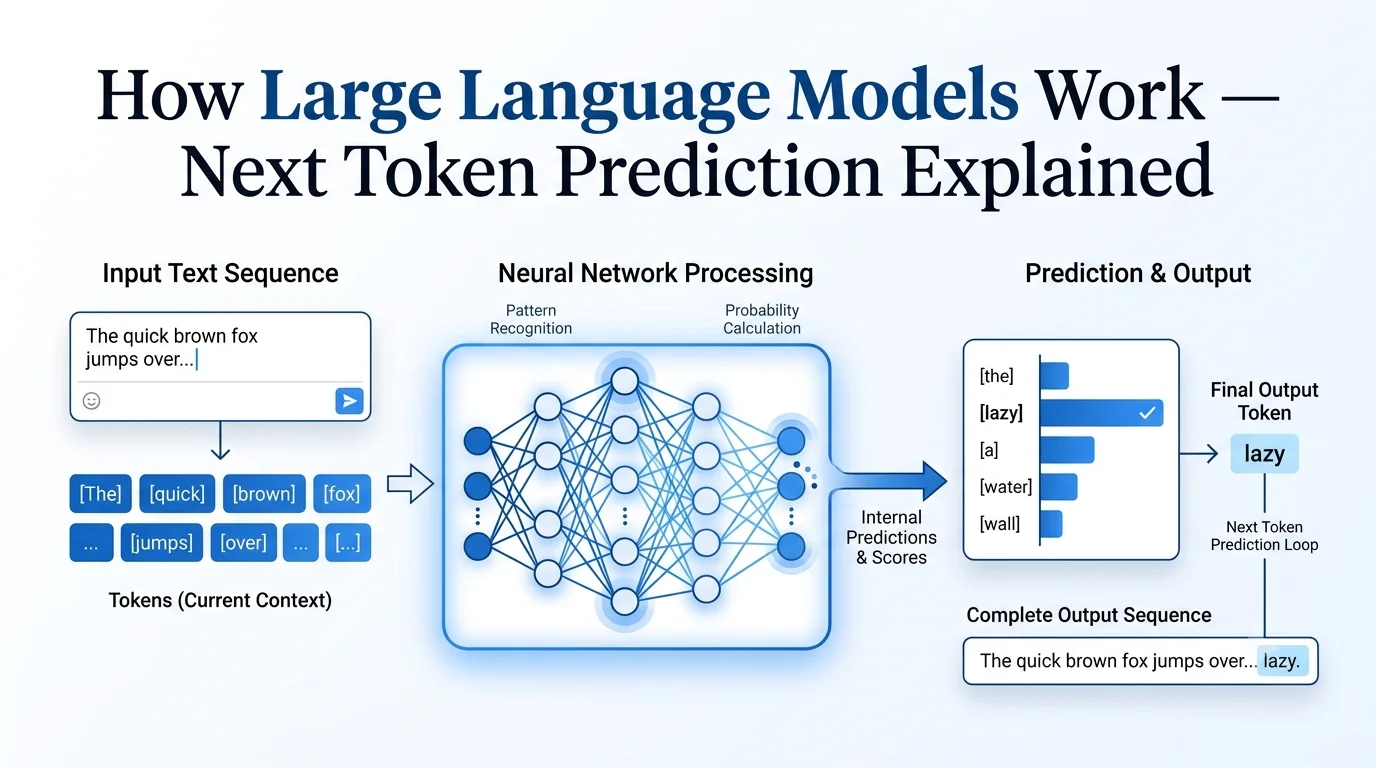
An advanced language model such as ChatGPT, Claude or Gemini possesses not any kind of fact database that it can reference. It does not go online to search for the answer to your question. Instead, it predicts the statistically probable next token, which it guesses upon taking into account everything that has been said until that point.
Consider the following analogy: have you ever met a person who has read tons of books and/or articles, and/or web pages but is unable to look anything up? When posed with questions, such person produces the answers relying exclusively on the information it has remembered. This person may sound confident, but confidence does not imply correctness.
If the model lacks sufficient signals in its training material to give you a right answer, the model will come up with something which might sound plausible but which is wrong. It cannot tell you whether the information it has produced is accurate or not.
Related read: Want to understand why even long-context LLMs struggle with memory — Context Windows Explained: Why Long-Context LLMs Still Forget Information
The Real-World Consequences — Why This Actually Matters
If you’re using AI to assist in creating social media content or brainstorming ideas, hallucination is merely an annoyance. You read it, discover it, and move on.
However, companies are now using AI for far more serious purposes. That is when hallucination becomes a serious danger rather than an annoyance.
Healthcare
A hospital uses an AI agent to help physicians get fast information about drug interactions and dosage instructions. If the AI gives some wrong figures on dosage, it’s not only a minor mistake. It’s a threat to patient safety. Clinical AI is not a helpful technology if there’s no reliable checking mechanism in place.
Finance and Law
A financial consulting business applies AI to help financial analysts prepare clients` reports and reference regulations and case laws. If the AI states about some regulations that do not exist or misquotes a regulatory document, the compliance team will be in trouble — not to mention the client.
Customer Service
A retail company uses an AI chatbot to help customers with questions regarding products, returns, and warranty. If the chatbot generates information on a nonexistent return policy, the company may have an upset customer and be liable for any organisation.
The above examples are real. At the present time, there are cases of companies in Canada using AI without much comprehension of its actual limitations.
Want to go deeper than just understanding RAG?
Proleed Academy’s AI program covers RAG systems hands-on — vector databases, chunking strategies, retriever types, and building production-ready RAG pipelines. Live sessions, real projects, globally recognised certification.

Enter RAG — What It Is and Why It Works
The letters “RAG” stand for Retrieval-Augmented Generation. While it seems like a complicated abbreviation, it has quite an easy explanation.
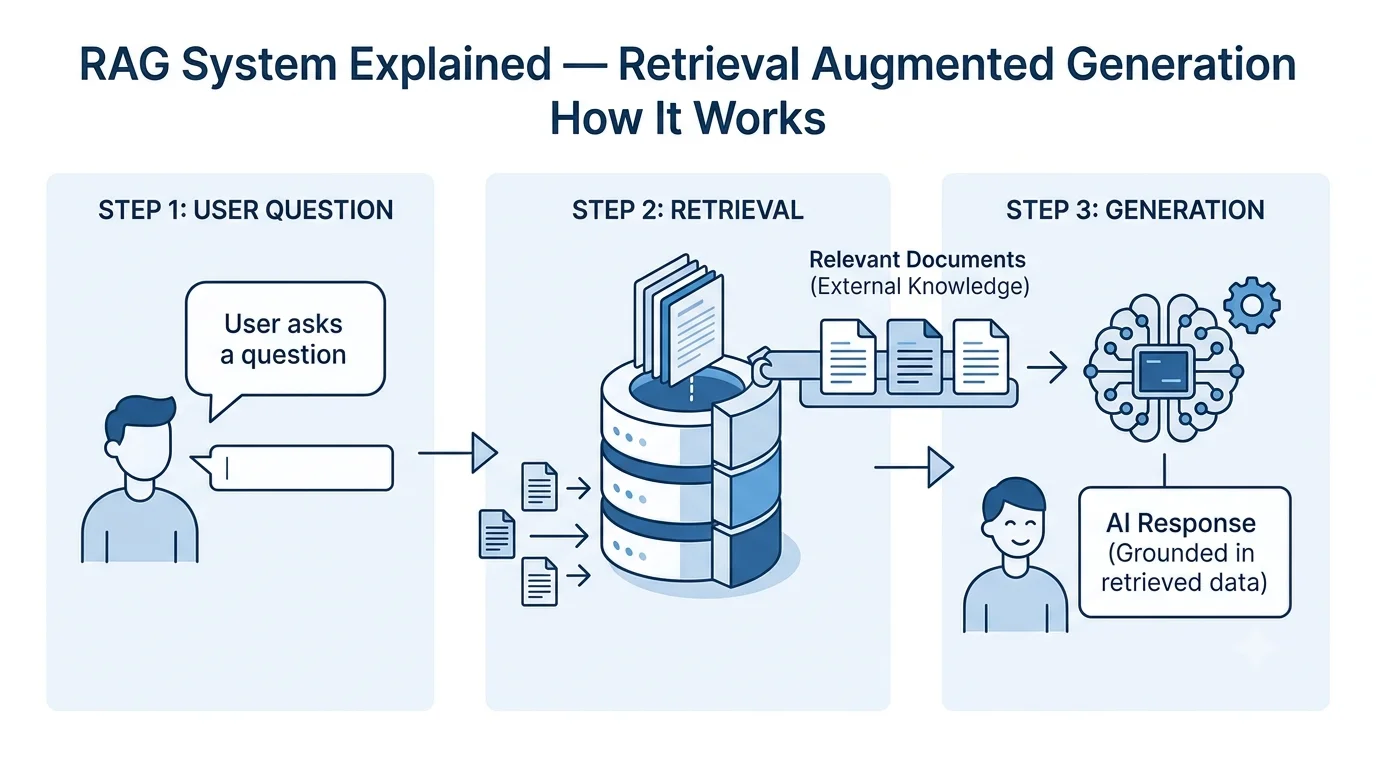
Assume that you have to ask advice from two types of people. The first type gives you the answer based on memory – the response is quick and confident, but half-accurate as the grasped information may not be correct. The second type says, ”I will check it for you,” then goes to check the document, rules or records, and provides you with an answer based on those documents.
The essence of RAG is that AI works like the second type of person. So, instead of generating responses based on the information accumulated throughout training, RAG first retrieves the related documents and information from the connected knowledge base and only then formulates the answer.
This way, this technology allows AI to respond using the current return policy or current regulation obtained from the relevant document. It provides the answer to a clinical issue based on the current clinical guideline instead of relying on the memory.
A straightforward analogy: A traditional LLM is a gifted student responding from recollection during an examination. A RAG system refers to that original student, but in this case, the examination is open book. Similar knowledge, however much higher accuracy in the case of actual facts.
RAG in the Real World — How Canadian Businesses Are Using It
RAG is not a technology for the future but is already being used for various purposes in different sectors, including Canada.
Banking and Financial services
Canadian banks are applying the RAG technology in the development of AI assistants, which help compliance teams. Unlike LLMs, which reference compliance requirements based on prior training data, the RAG-enabled system literally references the necessary documents at the time of the inquiry. Whenever OSFI issues a new guideline, the system pulls the newest update from the document.
Healthcare
Some health organizations within Canada have begun to use RAG technologies to link the knowledge libraries with AI assistants, including drug formulary, treatment protocols, and treatment guidelines. Whenever a nurse asks about the effects of a specific compound, the AI system retrieves the relevant page from the library and gives an answer.
Retail and E-Commerce
Retailers within Canada are starting to use RAG-enabled assistants to serve their clients through real-time inventory systems with up-to-date catalogues, price lists, and policy documents. For instance, when the customer asks how long it is possible to return the purchase, the AI assistant retrieves this policy directly without making any guesses.
Related read: Want to understand how RAG compares to fine-tuning for real business applications — RAG vs Fine-Tuning: What Works Better in Real Products

What You Need to Know to Build RAG Systems
Having a clear understanding of RAG is beneficial. However, the ability to perform RAG in real life helps you become appealing to employers using it.
Here’s how to build a RAG system capable of functioning in a production environment:
- Vector databases – there’s no keyword search in using RAG. Words are transformed into data formats called embeddings and saved into the vector database. The query is all about the discovery of the closest meaning to the question asked. The tools for that are FAISS, Pinecone, and Chroma.
- Chunking strategies – documents are broken into pieces before being added to the database. If it is too big, there is an accuracy issue. If it is too little, the context is lost. One of the most underrated skill sets in RAG engineering is knowing how to chunk correctly.
- Retriever types – dense, sparse, and hybrid retrieval types prove to have different advantages depending on the type of knowledge database.
- Re-ranking – retrieved documents may not always be equally useful. Re-ranking layers help to assess the relevance of retrieved chunks prior to sending them to the LLM.
- Assessment – in order to determine whether your RAG system functions, you will need specific evaluation criteria – fidelity, relevance of the answer, precision of scope. This is a whole area of knowledge by itself.
This is just a part of the whole picture which the article can specify. If you want to create a functioning RAG pipeline — solving edge cases, maximizing the efficiency of retrieval process, implementing the technology on a cloud infrastructure — you will need practical hands-on training with real tools involved. This is fully covered in Module XXV of Proleed Academy’s AI Program.
Related read: If you want to go deeper on evaluating RAG systems specifically — How to Evaluate RAG Systems: Key Metrics Every AI Engineer Should Know
Some answers to common queries
Ready to Build RAG Systems Yourself?
Proleed Academy’s AI programme covers everything in this article — and everything beyond it. Module XXV takes you from understanding RAG to building and deploying production-ready RAG pipelines with real instructor guidance.
About Proleed Academy
Proleed Academy offers live online AI training covering machine learning, deep learning, generative AI, LLMs, RAG systems, agentic AI, and model deployment. Students across Canada, the UK, and South Asia. Visit proleed.academy