Table of contents
- Everyone Is Talking About It - But What Actually Is It?
- Traditional AI vs Generative AI - The Real Difference
- How Generative AI Actually Works - The Intuition Behind It
- What Generative AI Can Actually Do - Real Examples Across Industries
- Generative AI vs Traditional AI - Where Each Fits
- The Limitations of Generative AI - What It Cannot Do
- What Generative AI Means for Your Career in Canada
- Here are some answers to the most commonly asked questions
What Is Generative AI? And How Is It Different From the AI You Already Know?
Everyone Is Talking About It - But What Actually Is It?
It is currently impossible to be online without coming across the phrase “Generative AI” or “GenAI”. It has made its way into headlines, job descriptions, meetings, and discussions taking place at legislation. The companies are launching generative AI advances. Colleges are revising their programs to include it in their courses. Companies are aiming to figure out its meaning for their businesses.
Unfortunately, people will most likely not be capable of explaining what generational AI really is or how it differs from AI developed years ago. “It is like ChatGPT”, “It is something that generates things”, or “It is a new kind of AI”.
Although these definitions are not wrong, they are not entirely accurate either. Generative AI is a certain type of AI that employs a certain set of technologies and specific capabilities.
Level of implementation: ChatGPT produces around 2.5 billion prompts daily. The use of generative AI platforms has increased by 70% yearly, reaching 9.5 billion visitor engagement per month. It was shown that generative AI has been applied by 94% of business buyers in 2025.
Traditional AI vs Generative AI - The Real Difference
The technology of AI has been in existence for a long time. Applications such as spam filtering, recommendation systems, fraud detection systems, GPS, and others are examples of AI. However, how is generative AI different from AI which has long functioned behind the scenes in the digital world?
The difference lies in the function that AI is to carry out.
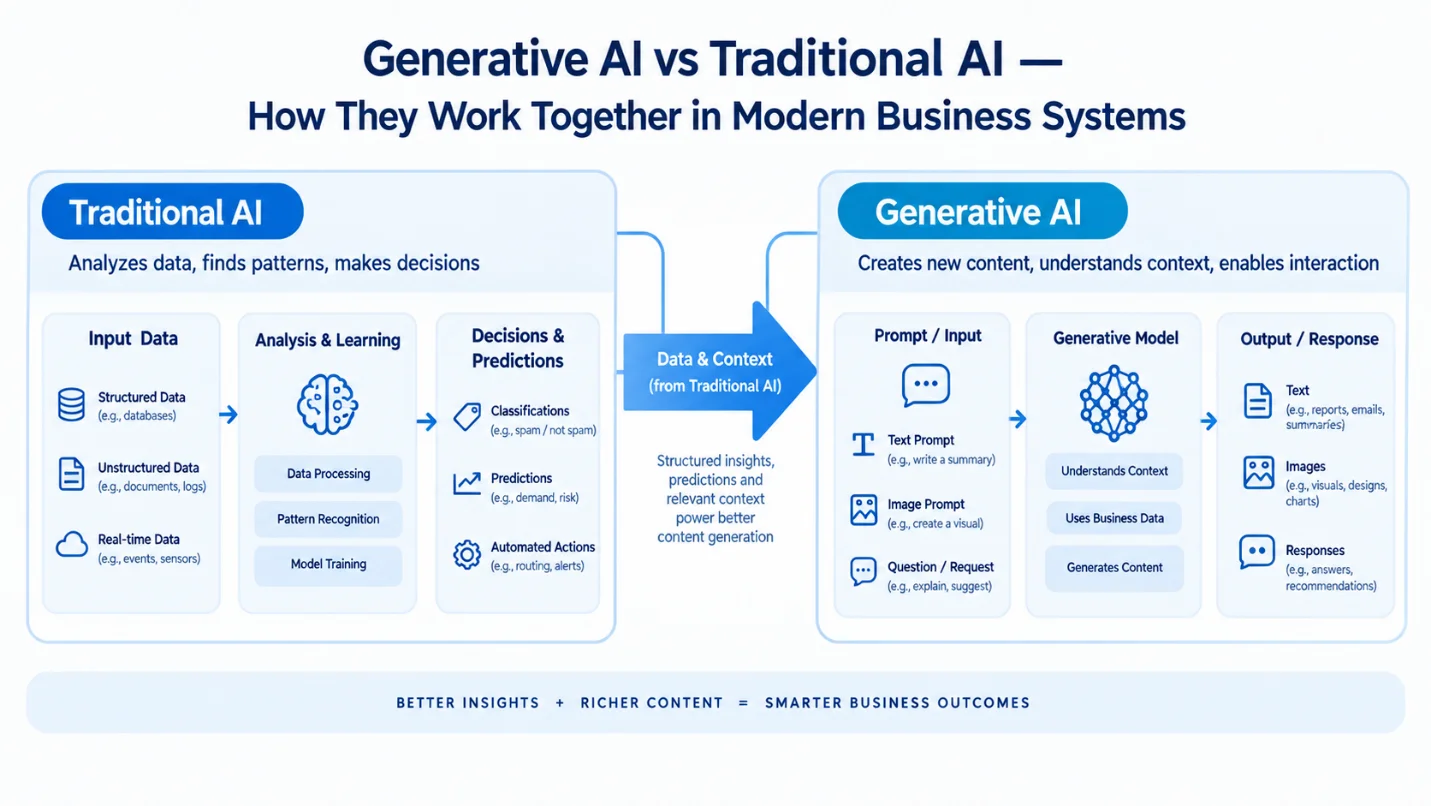
Regular AI takes the input and decides about it. Is the email spam or not? Is the customer going to leave or stay? Is the transaction fake or no? The AI analyzes existing data, classifies it, ranks it, or forecasts something. Regular AI merely makes judgments about existing data.
Generative AI functions differently than that. It takes input and creates new things. Write an article on climate change. Draw an illustration of a mountain during the sunset. Compress the document containing 50 pages to only three paragraphs. Simplify the legal agreement.
What is meant by this shift is very simple. AI is now evolving from one that can analyze and make decisions to the level of creating and producing. This revolutionizes everything regarding AI in the professional field.

How Generative AI Actually Works - The Intuition Behind It
Large Language Models: The Mechanism Behind Generation of Text
Each time you enter a prompt in ChatGPT, Claude, or Gemini, you always engage with the Large Language Model, or LLM. These models were taught to deal with immense volumes of texts — books, articles, online resources, web pages, conversations, etc. — and learned the principles of functionality of language.
When an LLM receives a question from the user, it does not refer to the database of ready-made answers; it generates a response one word at a time, predicting which of the available tokens would be the most suitable for the answer. The output may be correct and very informative or incorrect but plausible whenever there are doubts from the side of the LLM. Both the possibilities and limitations of generating AI should be known when working with it.
Diffusion Models -- Technologies for Generating Images
Diffusion models are different from LLMs in their functions. They are based on the principles of adding noise to images in gradual steps until there is pure randomness, and then learning to reverse this process. After receiving a textual input, a diffusion model starts with noise that it transforms into an image sooner or later matching the input. The result is an image that can be photo-realistic, painterly, or stylized at best.
The Main Idea
Regardless of whether it is text, images, audio, video content, or code, generative AI systems apply similar principles. They acquire patterns applied in lots of examples of content and use them for producing new instances of content. The types of content, architecture, and training data may vary, but the main principle of generative AI systems stays the same.
Related read: Understand why even the best generative AI systems can get things wrong — and how RAG fixes it — Why AI Chatbots Give Wrong Answers — And How RAG Systems Fix That

What Generative AI Can Actually Do - Real Examples Across Industries
The best way to comprehend how generative AI works is to look at its current applications in various fields.
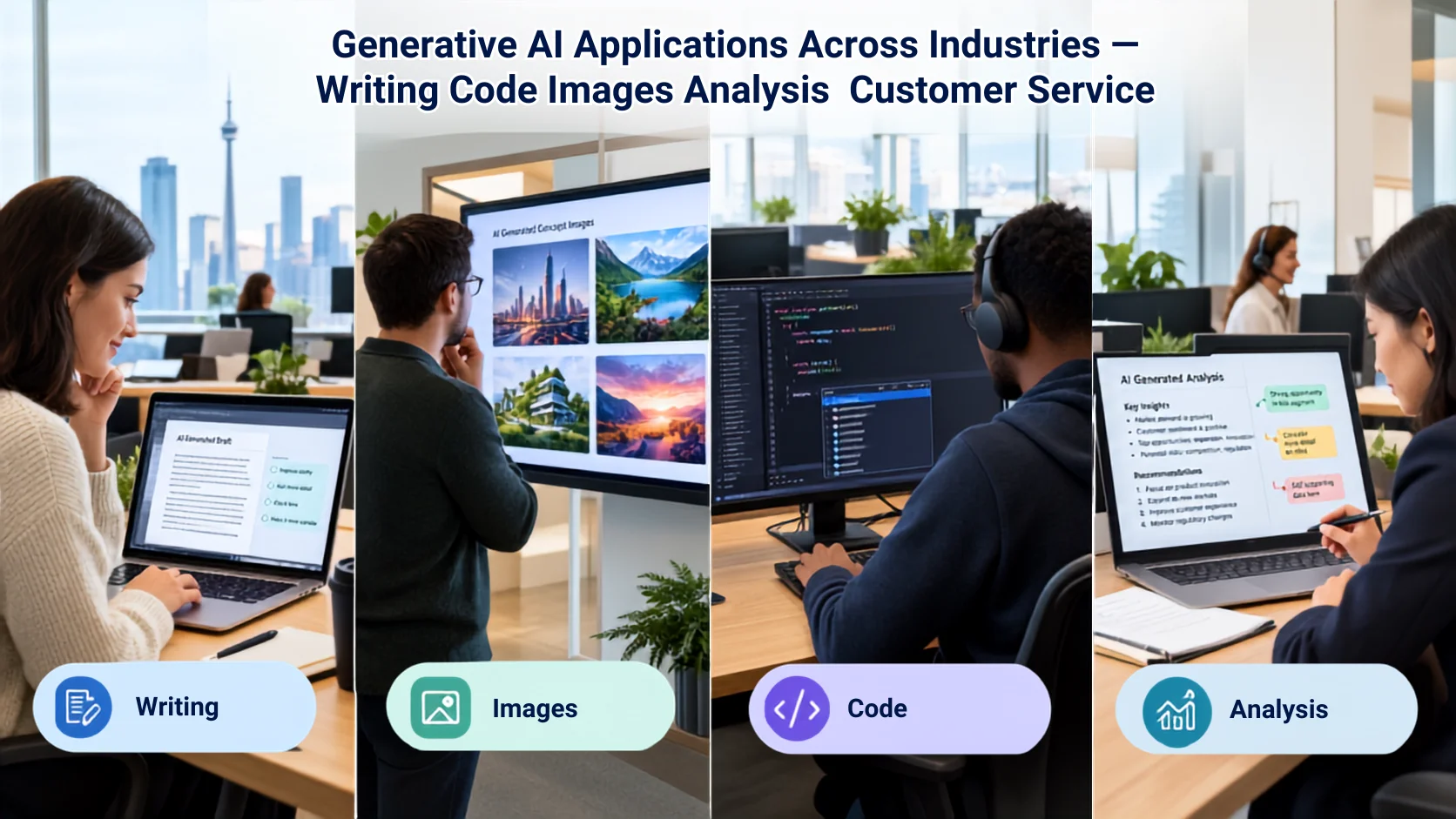
Writing and Content Generation
The generative artificial intelligence can create articles, reports, emails, brochures, legal documents, job advertisements, social media posts, and product descriptions. It doesn’t substitute professionals who know their field, it rather accelerates drafting processes. For instance, a financial analyst who used to spend four hours preparing a report for a client now needs only forty minutes to review a report drafted by AI. The ability to analyze the results of work is not going anywhere; it remains completely human.
Code Generation
GitHub Copilot is a generative AI application that helps developers write code in real time – it provides suggestions on function creation, finishing sentences, as well as gives a plain English explanation of its functioning. Software development teams from Canada report a productivity boost of 30-40% in certain tasks. Developers are not replaced by Copilot, as they start concentrating on other, more important aspects of work rather than on the monotonous process of coding.
Image Generation
Marketing employees of Canadian companies are relying on generative AI technology to create visual concepts in a matter of minutes instead of weeks. With a single brief to a generative AI tool, multiple visuals are created whereas when a single brief is sent to a design house, it takes time before a single visual is produced. The designer does not have to come up with each visual but rather oversee the process.
Summarisation
Various legal practice organisations are utilising generative AI technology for summarising lengthy legal contracts, extracting key information, and identifying the non-standard clauses. On the other hand, medical facilities employ this technology to summarise large number of medical records. Executives are making use of the technology to turn lengthy reports into executive summaries unlike in the past.
Customer Service
Generative AI enables the creation of a new generation of chatbot technology for customer service. Rather than retrieving previously crafted text, generative AI-powered chatbots can respond to complicated inquiries. The main distinction between the previous chatbots and newer ones is the difference between self-serve vending machine and a friendly colleague.
Would you like to progress from merely grasping Generative AI to implementing it?
Proleed Academy provides a comprehensive Generative AI course that includes lessons on large language models, prompt engineering, retrieval-augmented generation (RAG) systems, and real-life usages of GenAI technology. This course is designed for professionals who want to learn practical skills rather than theory.
Visit proleed.academy to find out more about this course!
Generative AI vs Traditional AI - Where Each Fits
There is an impression that generative AI will replace the conventional AI systems. This is not correct since both systems serve different purposes and are often used together.
Traditional AI, for example classification, prediction, and anomaly detection, is still responsible for fraud detection at banks, spam filtering in emails, and recommendations on platforms like Netflix. Traditional systems are very efficient in their operation and generative AI does not change that.
The most important distinction about generative AI is that it enables creation, synthesis, communication and explanation — functions impossible for traditional AI. For instance, when a fraud detection system (traditional AI) detects suspicious transactions, a generative AI system is used to generate letters of notification explaining the reasons and measures to take. Both systems are needed and necessary.
It is essential to perceive generative AI as a different layer of AI rather than the technology replacing conventional AI.
The Limitations of Generative AI - What It Cannot Do
All articles regarding generative AI must include this section. The reason is not that the technology is unimpressive but due to the fact that those individuals who are really good at using it are those who know the limits of the model as well as its capabilities.
Hallucination
Generative AI can create wrong information which seems 100% correct to us. It is ignorant of what it doesn’t know. Whenever there arises a situation where the model is not sure about something, it will take the option of going for the answer which statistically is more probable. This indicates that the generated information has to be checked.
Absence of up-to-date information
Most of the generative AI models have a cutoff date for the training data they were trained on and they do not know what happened after that date if they do not have access to some sort of retrieval system or online search function. Thus, inquiring a LLM about yesterday’s news is like asking a person who has not read a newspaper for months.
Bias in Training Data
Generative AI models acquire the discriminations which exist in their training data. When the training data is biased towards some groups and tendencies and makes them appear more than they are, that will affect the outputs of the models. This does not have a simple solution and requires regular checks, proper practices in assembling diverse training data, and human intervention.
Lack of True Understanding
Generative AI creates outputs seeming to be wisdom. It generates complicated concepts, responds to difficult inquiries, and speaks intelligently. But this is not understanding in a human way as it only makes connections between information at a very high level. This difference is significant in terms of deciding how much one should trust generative AI outputs without verification.
What Generative AI Means for Your Career in Canada
This is the question that professionals come to — and it deserves to be answered directly.
Generative AI will not take over most jobs. Yet, it will change the nature of those jobs – time will be spent less on mechanical work and more on management, solutions evaluation, refinement, making judgments, etc. Those professionals that embrace this change will significantly boost their productivity. And those who do not will find themselves doing the same amount of work as they did before.
The Canadian job market reflects this already. Jobs that previously required a full day of document writing, report writing, or programming are gradually transforming into jobs that require not only the aforementioned skills but also the knowledge of how to use generative AI efficiently. In Toronto, Montreal, Vancouver, and Calgary, job descriptions are requiring the application of AI skills in the most diverged spheres including law, marketing, finance, healthcare, engineering, etc.
The most successful professionals in utilizing generative AI are not the people who know how to use it but those who know how generative AI works and where its weaknesses are. This knowledge is what Proleed aims to cultivate in its learners.
Here are some answers to the most commonly asked questions
Generative AI is an abbreviation for artificial intelligence technology that produces new things such as text, images, sound, video, and code based on input. While standard AI studies the present data and makes decisions, generative AI creates a new product, virtually coming into being because of a request made by a user.
Traditional AI processes the present data and creates a prediction or makes a conclusion out of it. On the contrary, generative AI creates a new product altogether. For instance, a spam filter operates as a traditional AI as it makes a decision about an email that is spam. At the same time, ChatGPT acts like generative AI since it produces a piece of new content distinctly from anything available.
Generative AI consists of ChatGPT, Claude, and Gemini text generators on one side and DALL-E and Midjourney picture generators on the other side. Also, we have GitHub Copilot as coding tool. Smart Compose in Gmail makes use of generative AI to suggest continuations to sentences. Generative AI is used by such voice technologies as Siri and Google Assistant. Today most AI solutions you use in your life contain some generative AI solutions.
Absolutely yes, and the demand for generative AI practitioners is growing. Hiring companies in Canada need employees qualified and experienced in generative AI technologies that are applicable in different industries, such as finance, healthcare, legal, marketing, and IT.
Generative AI Course
Full AI Programme
Not sure which fits you? Book a free demo class — we’ll help you decide.