
Table of contents
- Introduction
- What Is RAG Evaluation? Understanding the RAG Evaluation Problem
- The Three Layers of RAG Evaluation
- Important Like How to Measure Retrieval Metrics
- Generation Metrics That Actually Matter
- End-to-End RAG System Metrics
- LLM-Based Evaluation Approaches
- Common Mistakes When Evaluating RAG Systems
- Best Practices for Reliable RAG Evaluation
- Conclusion
- Frequently Asked Questions
How to Evaluate RAG Systems: Key Metrics Every AI Engineer Should Know
Introduction
RAG (Retrieval-Augmented Generation) has been increasingly adopted in AI because it allows for a combination of information retrieval along with large language models to create answers that are based on outside sources of knowledge.
However, evaluating RAG systems is more complex than evaluating traditional machine learning models because errors can occur in both the retrieval and generation stages, making it difficult to determine which component (retriever, generator) is responsible for failures.
Understanding how best to evaluate these types of systems is critical for AI engineers developing systems that function reliably. As a result, many applied learning opportunities, such as structured AI training programs, actively incorporate system evaluation activities into the overall development of AI models. This article discusses the essential metrics that are important to consider when evaluating Retrieval-Augmented Generation (RAG) systems.
What Is RAG Evaluation? Understanding the RAG Evaluation Problem
RAG evaluation measures the effectiveness of retrieval, generation quality, and overall system performance in retrieval-augmented generation pipelines.

RAG architecture is composed of two major components:
- A retrieval system that finds suitable documents or other knowledge sources.
- A generation system that produces the final answer from the retrieved documents or knowledge.
These components make it more complicated to evaluate RAG models than other models. Failures can occur at multiple steps in the pipeline:
- The retrieval system may return irrelevant documents
- The model could misinterpret the retrieved context.
- The LLM could hallucinate information that is contrary to what is stated.
Because of this complexity in evaluating RAG systems, it is difficult to determine accountability for error cases when only using the output of the generation system. An output could show to be wrong because the retrieval failed and not necessarily because of the generation quality.
There are many online open-source frameworks (such as LangChain and LlamaIndex) that allow developers to link retrieval, embeddings, and LLM reasoning together as one complete workflow. These types of frameworks help facilitate building RAG systems, but they do not remove the requirement for robust evaluation of RAG systems.
The Three Layers of RAG Evaluation
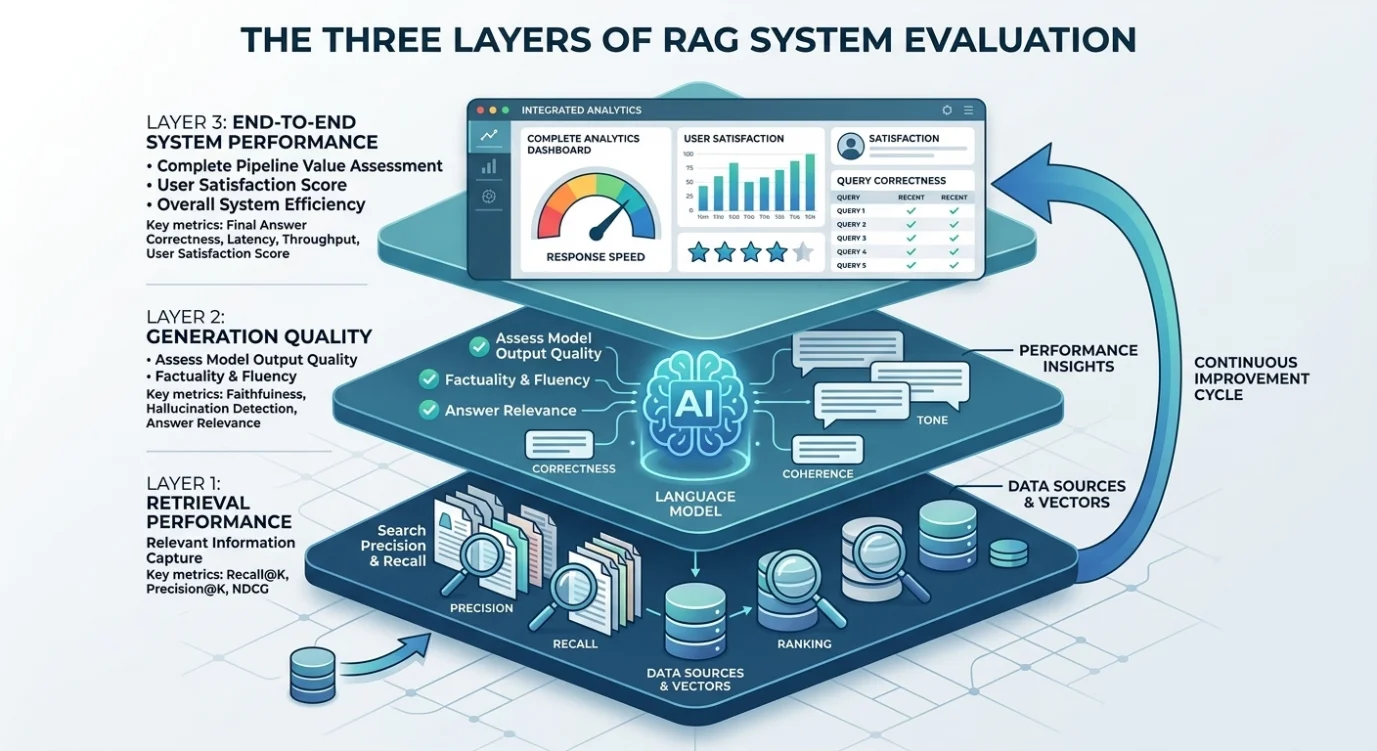
Engineers usually evaluate RAG Systems based on three primary levels of measurement of performance:
- Retrieval Performance: Retrieval Performance is a way to measure if the Knowledge Base produced relevant documents to use in the Language Model, and how those documents produced relevant results.
- Generation Quality: Generation Quality is a measure of how well the Language Model generates an answer to the query, based on the documents retrieved from the Knowledge Base.
- End to End System Performance: End to End System Performance is an evaluation of how well the entire system produced an output as an answer to the query.
Whenever an engineer evaluates the system, he must evaluate all three levels of performance simultaneously using a reliable method to accomplish this.
Important Like How to Measure Retrieval Metrics
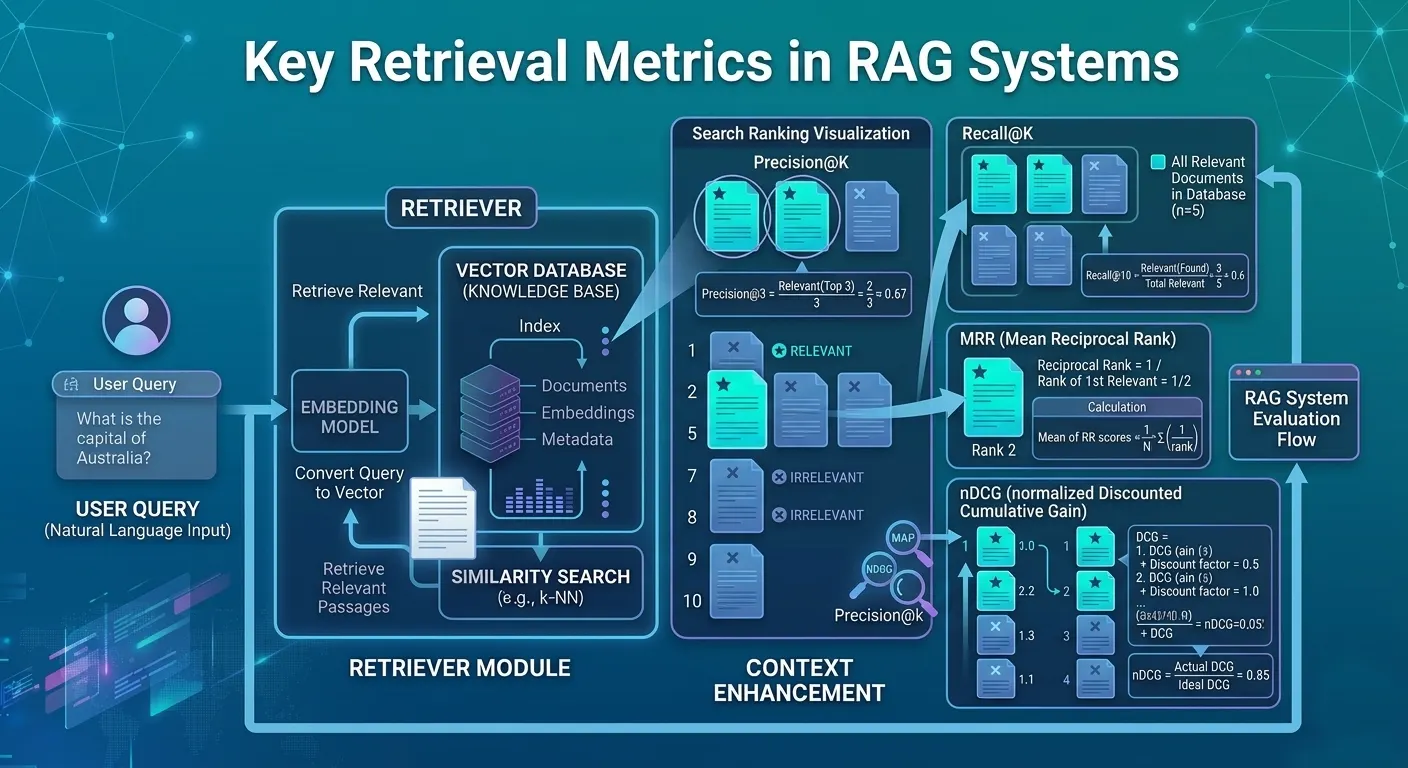
How good a system is at retrieving relevant content from its database is determined by retrieval metrics.
K-Level Precision
K-level precision refers to how many of the returned entries at K-level are relevant. For example, K-level precision is 0.7 when an information retrieval system returns 10 total entries, of which 7 are relevant.
This retrieval metric is particularly helpful when systems prioritize providing users with highly relevant material.
K-Level Recall
K-level recall measures how many of the relevant documents returned were actually relevant in terms of what the user requested.
A user with a high K-level recall will receive plenty of relevant content that was recently received by the information retrieval system and is necessary to create an appropriate response to the user’s inquiry.
Mean Reciprocal Rank
Mean reciprocal rank (MRR) measures the rank position of the first relevant document in an ordered list of entries returned from an information retrieval system.
The faster a user receives the first correct entry, the better the user determines that the information retrieval system is working the way it should.
This is especially important when a large component of the system relies on returning entries from the top portion of the list.
nDCG (Normalized Discounted Cumulative Gain)
nDCG assesses the quality of ranking retrieved documents based on where relevant documents are located. Therefore, this measure is common in the evaluation of search engines due to its consideration of the importance of both relevance and order of the ranked items.
Context Precision and Context Recall
These two metrics were created solely for the purpose of evaluating systems that employ RAG. They provide information about whether or not the retrieved context contains content that can be used to derive a correct reply to questions. Multiple studies have shown that the improvement of context precision significantly decreases hallucinations in RAG-generated replies.
Generation Metrics That Actually Matter
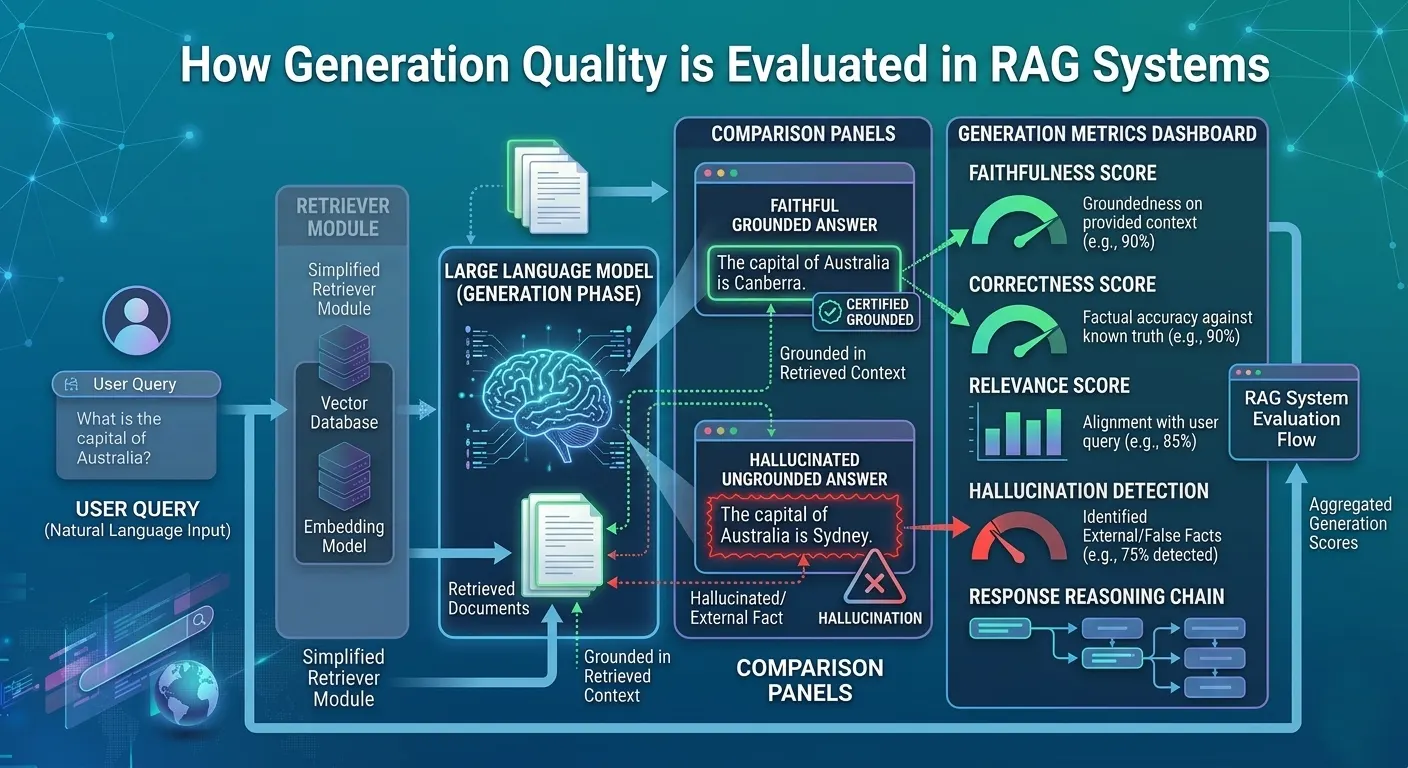
After retrieving the appropriate documents, an evaluation of the quality of the generated output should be undertaken.
Many Retrieval Augmented Generation (RAG) systems leverage large language models such as GPT to generate answers based on retrieved context from past documents.
Faithfulness: Faithfulness assesses whether a generated response is grounded in the obtained documents.
If a generated response contains information that is not represented anywhere in the retrieved context, the model is likely generating hallucinations.
Relevance of the Answer: This metric evaluates how well a generated response answers the user’s request/question.
Even if a generated response is factually correct, it may not be relevant to the question that was asked
Correctness of Answer: Correctness of answer evaluates whether the generated output is factual.
Many times, expertise and/or reference answers are used to evaluate correctness of the generated output.
Hallucination Rate: Hallucination is the term used to describe the experience of a language model generating content that is invalid according to the retrieved documents.
One of the major objectives of RAG architectures is to decrease the number of hallucinations produced by the language model.
The decision to use retrieval as opposed to base model’s knowledge can be very difficult to make. A discussion of retrieval-based vs fine-tuning systems was done in an earlier article regarding the use of retrieval in production environments; thus, if you are interested in this topic and want more information about how system design affects evaluation, you might benefit from reading the discussion in RAG versus Fine-tuning: Which Works Best for Real World Applications?
End-to-End RAG System Metrics
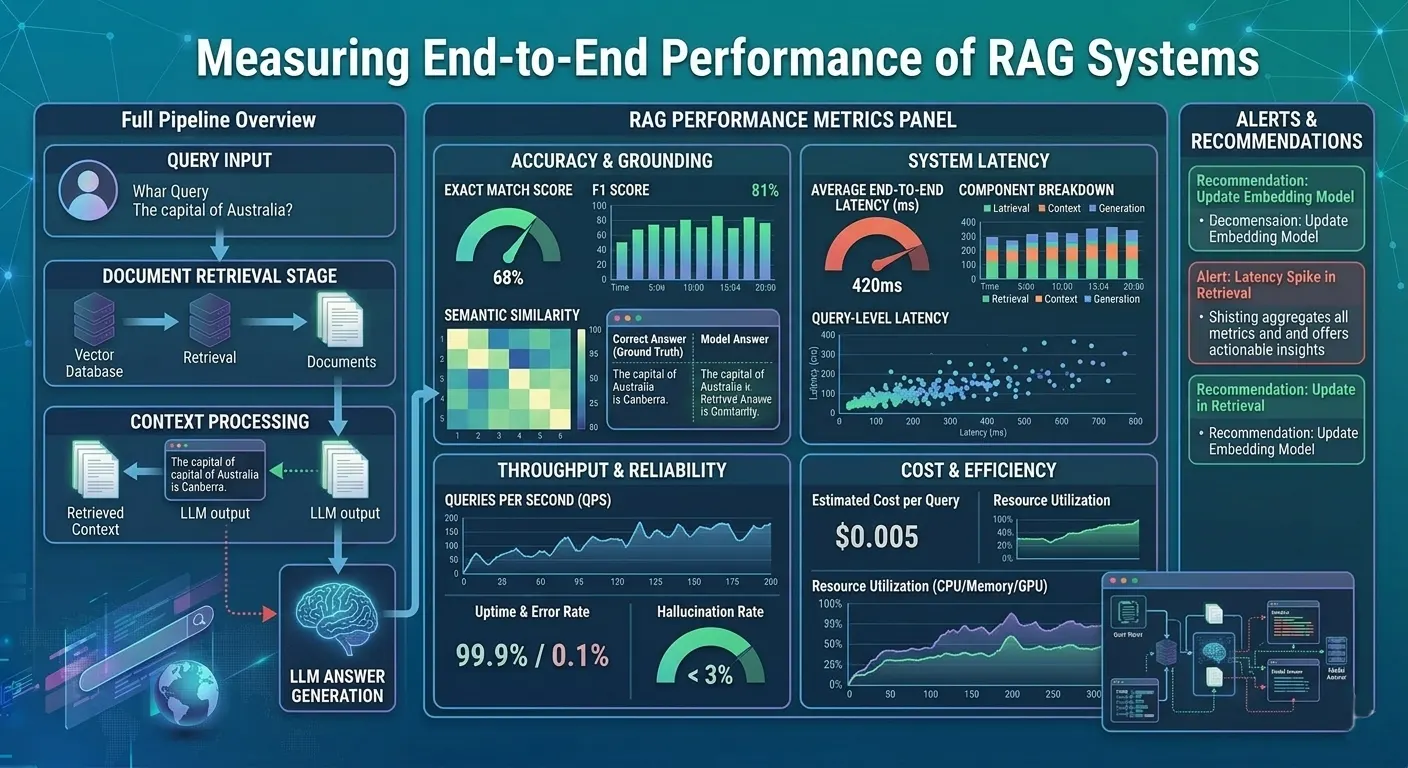
Apart from Measuring the Retrieval and Generation Metrics, Engineer’s Must Consider Overall System Performance.
Exact Match (EM)
Exact Match (EM) Measures whether or not the generated answer is exactly the same as the expected answer.
The Exact Match is commonly used as a metric of performance in Question Answering Systems.
F1 Score
F1 Score is the average of Precision and Recall and Measures how much the Generated Answer and the Reference Answer Overlap.
F1 Scores are helpful when EM’s are too strict to be used for Evaluation.
Semantic Similarity Scores
Similarity Metrics measure whether or not the generated answer Conveyed the Same Meaning as the Reference Answer, even if different Wording is Used.
Similarity Metrics are used to Evaluate Open-ended Responses.
Latency and Response Time
In Production Systems, Performance is not just about producing Accurate Results.
The Response time is an Important aspect of User’s experience as Well. RAG must Retrieve Documents, process Context, and Produce an Answer Quick Enough to Be Used Real-time.
LLM-Based Evaluation Approaches
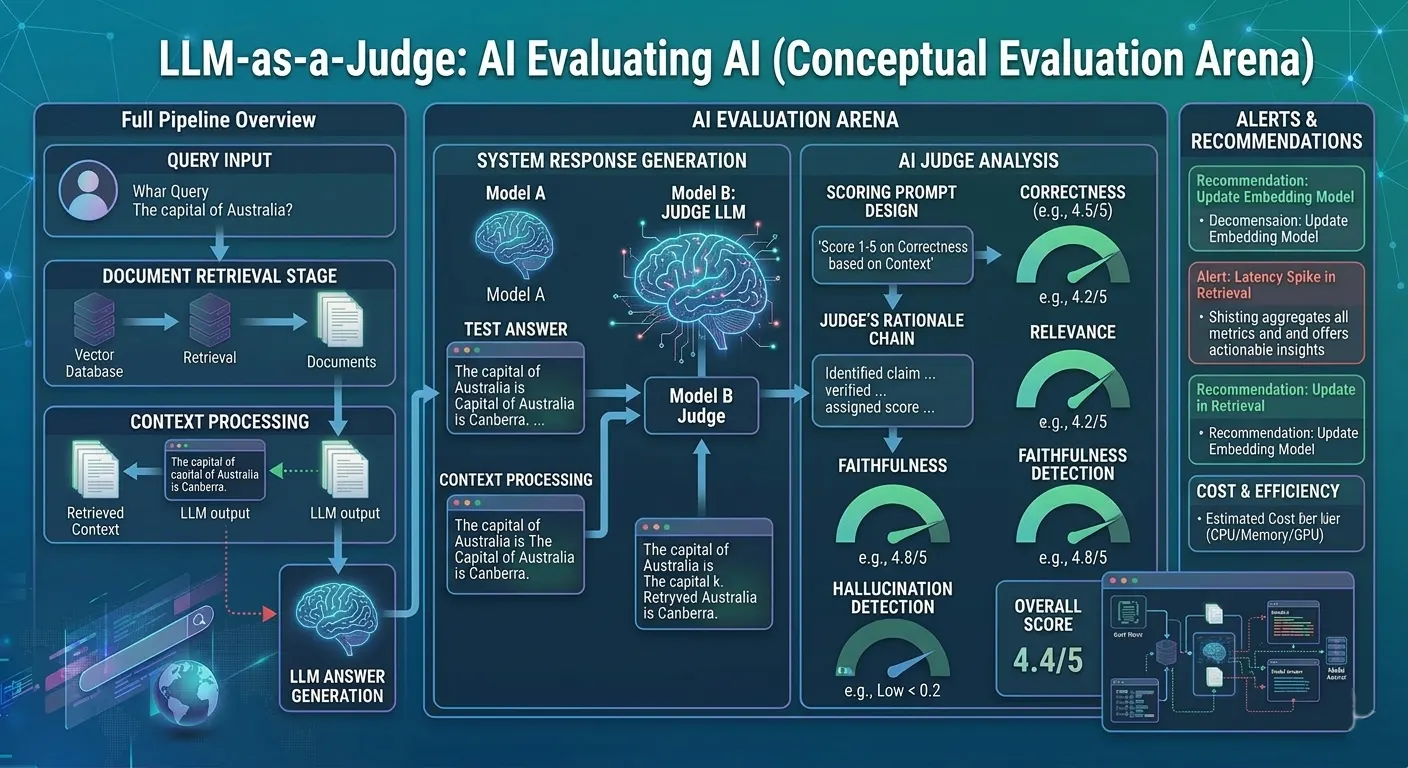
New evaluation techniques are being researched that leverage the capabilities of language models.
LLM-as-a-judge
Here, an LLM serves to evaluate the response quality that was generated by another LLM.
Evaluations consist of three major components:
- Correctness;
- Relevance; and
- Faithfulness.
This approach is increasingly common because it enables a scalable form of evaluation without the associated costs of large amounts of human annotation.
Pairwise Answer Comparison
In this evaluation method, two sample generated answers are compared, and an evaluator (either human or an LLM) is asked which answer is better.
This method is popular as an evaluation method, both for benchmarking different LLMs against each other as well as for conducting A/B testing within an LLM.
Common Mistakes When Evaluating RAG Systems
RAG evaluation can be difficult for teams since they are often concerned about the wrong metrics.
Some common pitfalls are:
Evaluating just the generated response – If you overlook the quality of your retrieval, you are missing out on potential major failures within your system.
Disregarding retrieval performance – Even the best language models will fail to produce an accurate answer without the right context to generate an answer.
Putting too much emphasis on one metric – Evaluating RAG requires evaluating a range of metrics at a variety of levels.
Best Practices for Reliable RAG Evaluation

In creating a trustworthy evaluation process, the majority of AI teams will use some combination of the following methods to evaluate their models:
- Use multiple layers of evaluation methods over time (eg. Retrieval level evaluations, Generation level evaluations & End-To-End evaluations).
- Use both automated and human evaluation methods to evaluate the same model. Automated measures can provide a scale for measuring performance whereas human evaluation provides a measure of reliability for a model.
- Review and improve the evaluation on an ongoing basis as new information is added to the knowledge base of the RAG system.
Conclusion
The evaluation of RAG systems demands an extensive approach that cannot be replicated when evaluating standard machine learning models. This is due to the fact that RAG architectures incorporate both retrieval and generation components and so require that engineers evaluate performance on many different layers in order to fully understand how the system works.
Metrics like Precision@K, Recall@K, MRR, fidelity, hallucination rate, and end-to-end performance metrics are useful to help determine how effectively a RAG system functions in the real world.
For AI engineers constructing production-ready systems, it is imperative to become proficient with these evaluation methods; a properly designed RAG architecture will significantly enhance knowledge-based AI applications, but only if it is evaluated for performance on an ongoing basis.