Join the League of 30k+ Participants Across 18 Countries Trained by Proleed

Proleed’s Data Analytics Training Course gives you practical skills in SQL, Python & BI tools to analyze data, create insights & build a strong career.
Average Salary of Data Analyst
Future of Data Analytics Career













As a person transitioning from a non-technical background into Data Analytics, I found Proleed's Data Analytics Training Course to be totally worth it. The structure of the course offered me the absolute basics to more advanced tools like SQL, Python, and Power BI. I benefited from practical projects that provided practical experience of real-world work; now I have sufficient confidence to pursue analyst positions.

Next Review

I’m already a data professional and wanted to advance my skills so I could remain competitive. By taking Proleed Data Analytics Course, I was able to strengthen my SQL and Python skill levels as well as learn advanced dashboarding in Tableau and Power BI. I found the data cleaning and EDA modules particularly beneficial and have been able to apply the skills that I learned to my job already.

Next Review

I took the Proleed Data Analytics Training to improve my career and obtain a more analytical role. The range of material included in the training from databases to predictive analytics provided me with an overall picture of the entire analytics field. I was able to complete real-world examples and projects that allowed me to build on my practical knowledge with an analytics emphasis which resulted in significant value for advancing my career.

Next Review
What is data analytics & its lifecycle
Analytical thinking & decision frameworks
Types of analytics: descriptive, diagnostic, predictive, prescriptive
Data analyst vs data scientist vs business analyst
Key roles and responsibilities in the analytics ecosystem
Real-world analytics pipeline (data → insight → decision)
Importance of data-driven culture in business
Tools and technologies overview in modern analytics
Understanding business problems and converting them into analytical questions
What is a database and its role in analytics
Relational vs non-relational databases
Tables, records, keys, and relationships
Database design and normalization
ER diagrams and schema structure
CRUD operations (Create, Read, Update, Delete)
Data constraints and referential integrity
Data warehousing basics
Connecting Python, Tableau, and Power BI to databases
Understanding databases, schemas, and tables
SELECT, WHERE, ORDER BY, GROUP BY, and HAVING clauses
Data extraction and transformation using joins and subqueries
Window functions (RANK, ROW_NUMBER, LAG, LEAD)
Common Table Expressions (CTEs) for complex queries
Aggregations, nested queries, and date/time manipulations
Creating and using views for analytics
SQL query optimization and indexing basics
Real-world analytics use cases and mini-projects
Setting up MySQL and MySQL Workbench
Writing and executing analytical queries
Importing/exporting datasets (CSV, JSON)
Stored procedures, triggers, and views
User roles, permissions, and data security
MySQL indexing and performance tuning
Integrating MySQL with Tableau and Power BI
What is NoSQL and why it emerged
Limitations of relational databases for modern data
Core NoSQL database types: Document-based, Key-Value, Column-family, Graph
Differences between SQL and NoSQL (schema, scaling, flexibility)
CAP theorem and BASE properties
Data modeling strategies in NoSQL systems
When to choose NoSQL over SQL in analytics workflows
Overview of popular NoSQL databases (MongoDB, Cassandra, Redis, Neo4j)
Connecting NoSQL systems to analytics tools
Introduction to MongoDB and BSON structure
Core components: databases, collections, documents, indexes
Installing and setting up MongoDB & MongoDB Compass
CRUD operations (insertOne, find, updateOne, deleteOne)
Advanced queries and filtering
Aggregation pipelines for analytical transformations
Data modelling and schema design for analytics
Indexing and performance tuning in MongoDB
Integrating MongoDB with Python (PyMongo and Pandas)
Introduction to Python and Jupyter Notebooks
Variables, control structures, and functions
Working with files (CSV, JSON, Excel)
Handling APIs and JSON data
Using virtual environments and packages
Automating data workflows
Integrating Python with BI tools
Introduction to NumPy and its role in data analytics
Creating and manipulating NumPy arrays
Indexing, slicing, reshaping, and stacking arrays
Understanding array data types and memory efficiency
Vectorised operations and broadcasting
Mathematical and statistical operations on arrays
Random number generation and reproducibility
Working with multi-dimensional (nD) data
Integration of NumPy with Python and pandas
Introduction to pandas and its importance in analytics
Working with Series and DataFrames
Importing and exporting datasets (CSV, Excel, JSON)
Data inspection and exploration (info(), describe(), etc.)
Data cleaning: handling missing values and duplicates
Filtering, sorting, and conditional selections
Grouping, aggregating, merging, and joining datasets
Feature engineering and date-time operations
Combining pandas with NumPy for advanced analysis
Basics of Matplotlib plotting
Seaborn for advanced statistical visuals
Creating bar, line, scatter, heatmap, and box plots
Customizing charts (titles, labels, grids, colors)
Subplots and multiple visual layouts
Storytelling through visuals
Automating reporting with Python scripts
Introduction to Statistics
Types of Statistics
Types of Data
Levels of Data Measurement
Mean
Median
Mode
Variance
Standard Deviation
Probability
Identifying missing values and imputation techniques
Outlier detection using statistical and visual methods
Data normalization and standardization
Encoding categorical variables (label, one-hot, ordinal encoding)
Dealing with inconsistent data and duplicates
Date-time formatting and time-series alignment
Feature scaling and transformation
Data validation and integrity checks
Maintaining data quality across pipelines
What is EDA and why it’s essential in analytics
EDA process: understanding data → cleaning → exploring → interpreting
Univariate analysis (distributions, histograms, box plots)
Bivariate and multivariate analysis (correlation, scatter, pair plots)
Identifying outliers and anomalies visually and statistically
Data summarization using descriptive statistics
Feature distributions and skewness detection
Handling categorical vs numerical data
Using pandas, Matplotlib, and Seaborn for EDA
Project: Perform full EDA on a real-world dataset (sales, HR, or e-commerce)
Best practices in data visualization and storytelling
Choosing the right visualization type for your data
Data-to-insight storytelling with visuals
Using Power BI, Tableau, or Looker for professional dashboards
Interactive filters, drill-downs, and slicers
Designing for non-technical audiences
Visual perception and color psychology in dashboards
Avoiding misleading or biased visuals
Creating automated, real-time dashboards
Power BI: DAX formulas, data modeling, and relationships
Power Query for data transformation in BI
Tableau: calculated fields, filters, parameters, and blending data sources
Google Data Studio basics and integrations
Dashboard design principles for executives
Data refresh automation and scheduling
Role-based dashboard access and permissions
Embedding BI reports into business workflows
Connecting BI tools to APIs and cloud databases
Tableau interface, workspace, and data connection setup
Data blending vs data joinin
Tableau Prep for ETL (cleaning, merging, reshaping data)
Dimensions, measures, and calculated fields
Table calculations and level of detail (LOD) expressions
Dynamic parameters and user-driven interactivity
Advanced visualizations (heatmaps, treemaps, waterfall, box plots, bullet charts)
Creating multi-source dashboards (Excel + SQL + API data)
Story points for narrative data storytelling
Dashboard actions (filter, highlight, URL, and sheet swapping)
Performance optimization and data extracts vs live connections
Publishing dashboards to Tableau Server and Tableau Cloud
Combining data from multiple workbooks & sources
Using Power Query for ETL (Extract, Transform, Load)
Advanced formulas with dynamic arrays (FILTER, SORT, UNIQUE)
Dashboard interactivity with form controls & buttons
Forecasting using Excel functions (TREND, FORECAST, LINEST)
Creating scenario analysis models & sensitivity analysis
Automating recurring reports with Power Query refresh
Linking Excel with Power BI for hybrid dashboards
Building Excel-based analytics projects
Introduction to Business Analytics
Key Performance Indicators (KPIs)
Types of Business Metrics
Sales & Revenue Analytics
Customer Analytics
Marketing Performance Analytics
Financial & Operational KPIs
KPI Dashboard Design
Business Report Creation & Interpretation
Data-Driven Decision Making
Identifying and defining KPIs & metrics
Root cause analysis and problem framing
Business experimentation and A/B testing
Decision frameworks: RICE, ICE, Pareto analysis
Communicating insights with data storytelling
Building executive summaries from analytics findings
Aligning insights with business goals
Measuring ROI and performance impact
Turning analytics into actionable strategies
Automating Excel workflows with VBA macros
Using Python scripts to refresh reports automatically
Integrating Google Sheets with APIs
Automating BI dashboards with Power Automate or Zapier
Sending automated email reports
Scheduling jobs with Task Scheduler or Airflow
Building reusable analytics scripts
Version control and collaboration with Git
Minimizing manual effort through smart automation
Marketing analytics: campaign tracking, ROI, funnel metrics
Financial analytics: budgeting, forecasting, variance analysis
HR analytics: employee attrition, engagement, hiring metrics
Operations analytics: process optimization, cost reduction
Sales analytics: pipeline performance, conversion ratios
E-commerce analytics: customer segmentation, basket analysis
Product analytics: feature adoption, retention etc.
Supply chain analytics: demand forecasting and logistics
Healthcare, education & fintech analytics examples
| Duration | |
|---|---|
|
4 Months (16 Weeks) |
|
| Schedule | |||
|---|---|---|---|
|
Weekdays Training Monday to Friday |
Daily Session
|
Weekend Training Saturday & Sunday |
Weekly Session
|
| US dollar | USD | 850 | 1300 |
|---|---|---|---|
| Canadian dollar | CAD | 1150 | 1600 |
| Australian dollar | AUD | 1280 | 1800 |
| Sterling pound | GBP | 660 | 1050 |
| New Zealand dollar | NZD | 1320 | 1900 |
| Indian rupee | INR | 65,000 | 95,000 |
Fee is inclusive of all applicable taxes and include examination and certification fee.
No other hidden charges of any type.
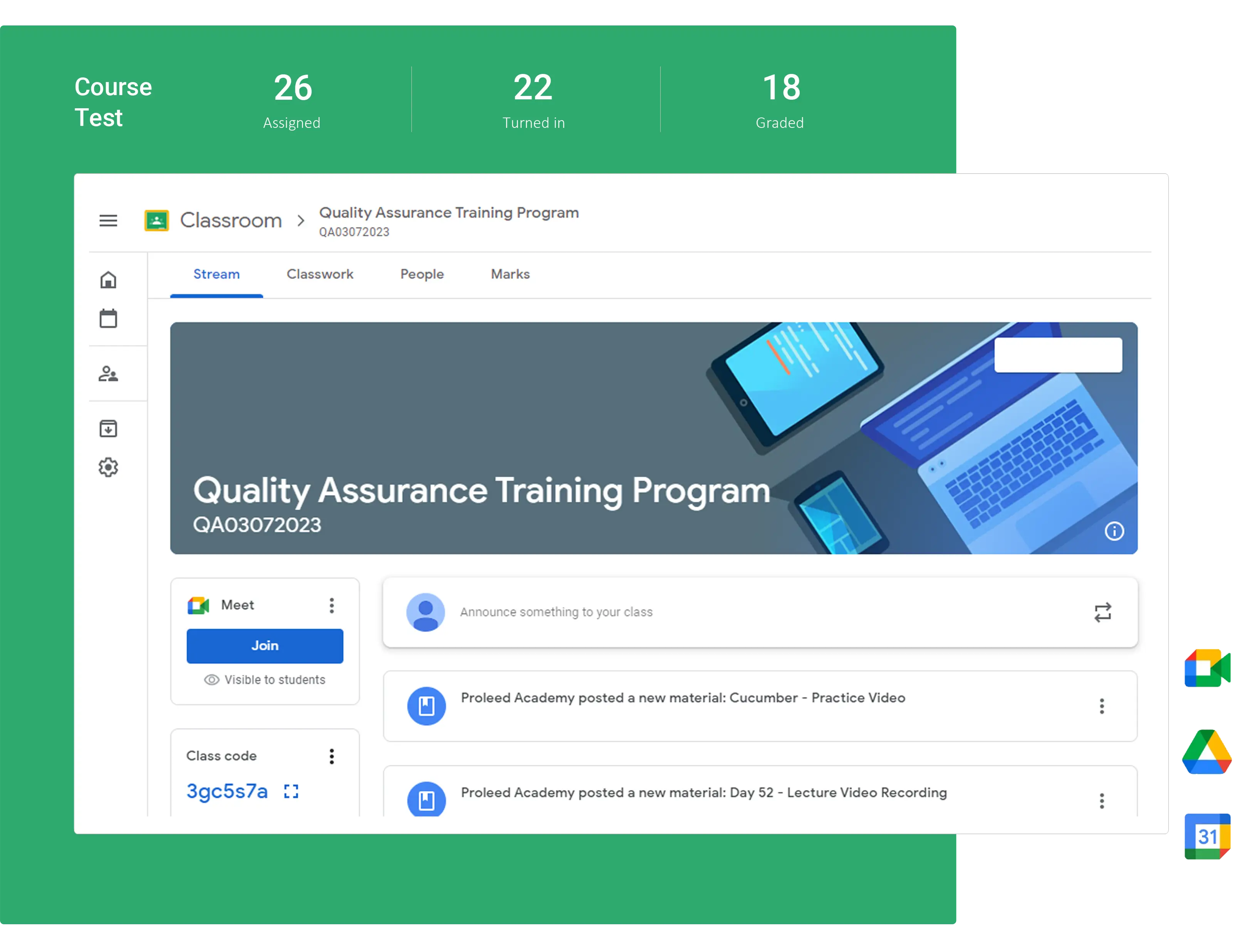
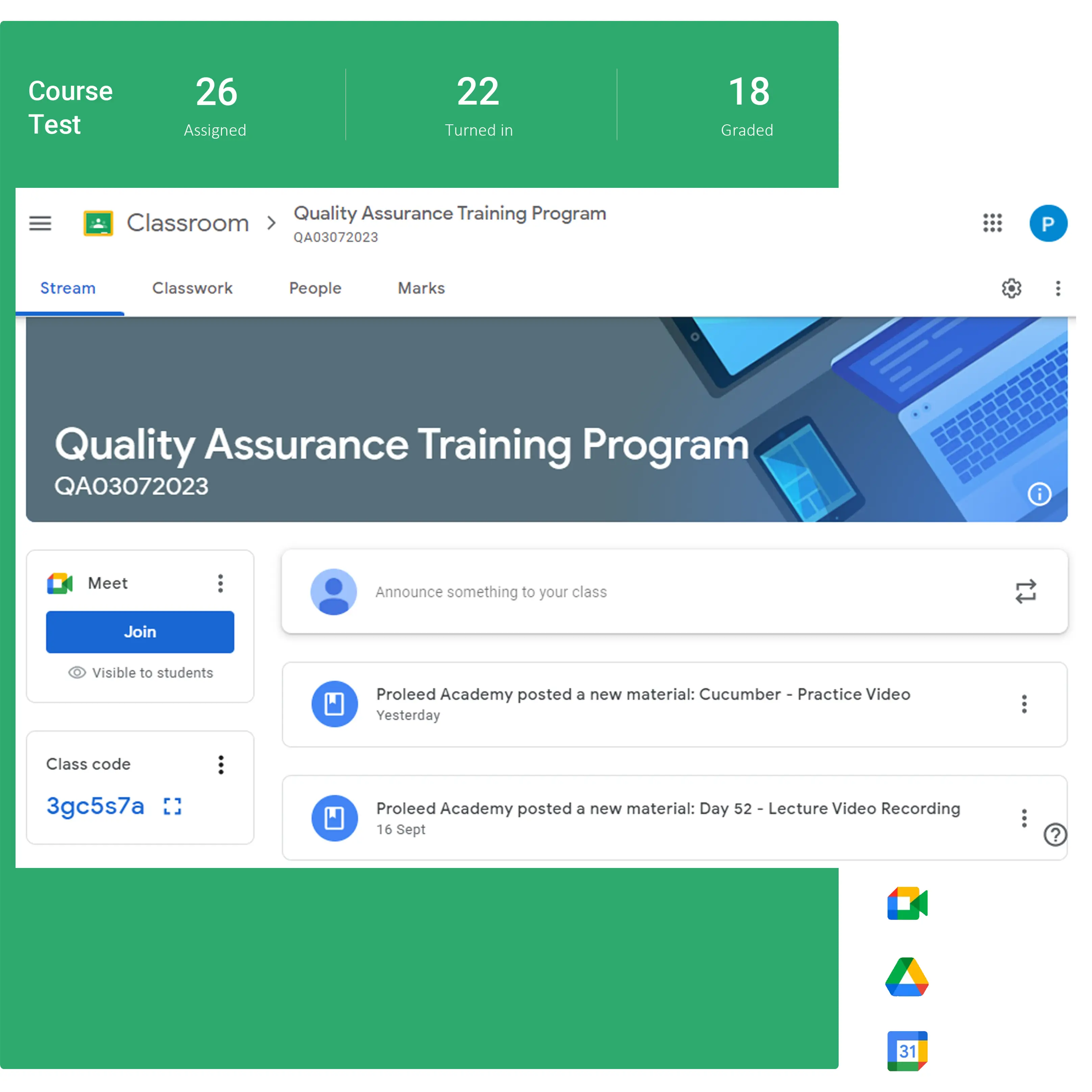
Get seamless, interactive and personalized learning experience
powered by Google Classroom.

Eco-friendly way of learning
Paperless, No hassle
Live training sessions where you can ask queries while the class is going on
Access learning material anywhere and anytime you need though out lifetime
Doubt clearance session after every class from the same trainer to resolve your doubts
Unmatched 10:1 Student : Trainer Ratio to ensure personalized attention to every student
Working on live projects to
enhance your practical skills and knowledge
Proleed's Data Analytics Training Course is carefully crafted to equip you with the practical skills needed to excel in the field of data analytics. Our program includes everything from the basics of databases and SQL for extracting data through to using the languages of Python, NumPy and Pandas for processing large amounts of data efficiently. You will also learn about cleaning data, preparing to work with the data, understanding that data when you look at it, and creating great visualizations using Matplotlib, Seaborn, Tableau and Power BI!
After developing these skills through the course, you’ll also have the capability of transforming unstructured into structured data and producing valuable insight for the purposes of making effective business decisions. Our program also provides you with guidance and support through creating and completing every project in a structured fashion as well as giving you the practical experience of working on live projects. Therefore, take advantage of this opportunity to begin your path toward becoming an employable, experienced Data Analyst who can change lives through the power of data.
At present, there are many job opportunities available for data analytic professionals around the globe. These opportunities have exciting career paths along with variety of choices in a very fast growing field of analytics. In today’s technological world of immense amount of data, companies require skilled individuals who have the ability to collect, clean, analyze and present data in ways that will facilitate their ability to make sound business decisions.
Businesses are currently looking for experienced data analysts proficient in database management, SQL programming, Python coding, Microsoft Excel, and business intelligence (BI) tools such as Tableau and Power BI to analyze unstructured data to create usable information. As there is an increasing need for professionals who possess analytical skills within the realm of big data, those who receive training in this field will have many different options across all types of sectors such as finance, marketing, operations, e-commerce & supply chain management; thus, the scope and potential for employment opportunities will vary greatly depending on where one chooses to work. The information contained herein describes some potential job opportunities available to individuals seeking careers with an analytical focus.










Proleed offers the daily doubt clearing session for providing the better learning environment to students.

Proleed has industry’s best placement preparation process
that enables our students to get their dream IT Job.

Our experts will help you to make professional resume for you.

We will help you to build / optimize your linkedIn profile.

We will provide you Interview Questions & Answers.

Our experts will take mock interviews to make you confident.

We will provider Guidelines to access placement Network.

Finally, You got your dream
IT job

Recognized Worldwide for IT Jobs
We provide certificate verification system to speedily verify our
student's certificates online.


We provide certificate verification system to speedily verify our
student's certificates online.
It doesn’t matter whether you’re from IT background or Non-IT background; our Data Analytics Training Course will equip you with the essential knowledge and skills to turn that passion into a rewarding career.


Demanding curriculum designed by industry experts
3+ Live Projects that includes real-time use cases
Hands-on experience on advanced tools, languages & technologies
Live doubt clearance session after every lecture
Placement Preparation Process

There are two types of projects Dummy or a Live Project. In our Data Analytics training course you will get the chance to work on live Project. Live Project means that you work for a Client and you have to make the project as per the client needs. But on the other side the Dummy Project is that, which is created by you without any interference of client. Both the project can be uploaded on domains, but at the time of an interview live project will get more preference.
Here, we accept payment through different modes like Master Card, Visa Card, and net Banking.
Absolutely yes, Proleed’s all training courses allow you to learn every concept in in-depth form. It includes all levels of training from basic to advance along with real life based live projects. You will also get valid certification after the successful completion of course, so there is a no requirement of doing any other certification course.
Proleed gives the additional advantage of placement preparation along with all courses. After the successful completion of the Data Analytics Training Course, students are ready for the technical round of an interview, but there are some more aspects that the students require for clearing the interview. Our specialized placement cell provides placement assistance to all candidates.
There is a three different ways by which the training is delivered to candidates;
No worries, if you missed a class you can cover that topic without any problem, because our all the live lectures are recorded also. So, you can get the recorded videos of those missed sessions.
The profession of a data analyst is one of the most promising and fast growing career paths in today's data driven world. However, to succeed in this field, it is crucial to have the right skills and hands - on knowledge.
Proleed's Data Analytics Training Course equips you with essential capabilities to become a confident, job ready data analyst. The full curriculum is inclusive of database basics, SQL and Python, through data preparation, exploratory analysis and data visualization via Matplotlib, Seaborn, Tableau and Power BI. With hands-on practice with real world business scenarios, and support from professionals, you will learn how to effectively analyze data, and produce results that can be acted on by companies, thus beginning your career path as a data analyst, with in-demand skills that employers are looking for.
Copyright © 2023–2026 Proleed Academy | All Rights Reserved.