
Table of contents
- Can a Non-IT Person Get a Job in AI in 2026?
- Let's Start With the Question You're Really Asking
- The Honest Answer — Yes, But Let's Be Specific
- What People Usually Get Wrong About 'AI Jobs'
- The AI Roles You Can Actually Get Without Coding
- The Skills You Actually Need (Hint: You Probably Have Them)
- Your Background Isn't a Problem — It's Actually the Point
- A Realistic Roadmap — 3 Steps, No Drama
- Choosing the Right AI Course When You Have No Tech Background
- Let's Kill Some Myths
- So — Should You Actually Do This?
Can a Non-IT Person Get a Job in AI in 2026?
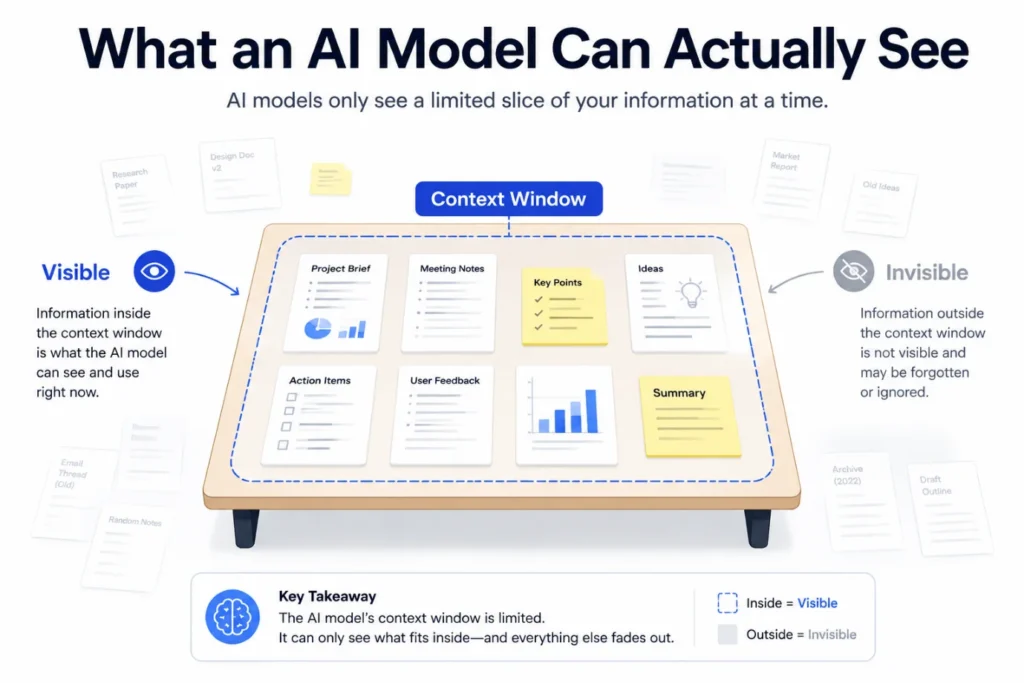
Many AI users have had a moment where they complete several complex instructions in a chatbot (by copy/pasting), and then add a large text document with a question at the end asking for a response. The model will generate a response as if it did not read half of what you sent; it creates confusion. The model does appear to have processed the text and at some point in the conversation it does correctly reference some of the things in your document, yet it seems that something important has been missed along the way.
To find out why you see that happen, we will need to discuss one of the most fundamental concepts in AI (however often misunderstood) — the context window, to truly understand it you will need to have a basic level of understanding relating to other concepts (i.e.: tokenization, attention, memory architecture, etc.). If you are just starting your AI learning, AI Course provides an excellent place to begin as it is broken down in such a way (from tokens to transformers) that every other part of this article will make sense to you much more quickly. Now we will elaborate further into this.
Let's Start With the Question You're Really Asking
You probably have wondered about this before, and have seen the headlines talking about AI is the future, AI jobs pay well, and AI jobs are everywhere, and then secretly thought to yourself, well, but is any of that actually for me since I am not a software engineer or have a computer science degree? The closest I have ever come to writing code is when I have created a large spreadsheet worksheet in Excel.
The first thing I want to say before we continue is that you are not alone in your concerns, and that may not be the answer that people are expecting.
Yes – you will definitely be able to find a job in AI in 2026, but what you need to know is that it depends on the job you want. There will be a large number of different jobs available so now let’s really take a look at it in detail.
Quick fact: According to the World Economic Forum, it is projected that AI will create 97 million new jobs globally and many of them will not require any coding whatsoever. |
The Honest Answer — Yes, But Let's Be Specific
I want to clearly say that there are a lot of places giving you advice about your career that make it seem like AI can only be your career if you are an engineer – this is not true. AI is a complex ecosystem, with many different roles, skills and pathways to get into AI.
Many of the roles that are in AI require technical knowledge – e.g., if you are a machine learning engineer you are expected to have knowledge of Python, statistics, and data infrastructure. This is absolutely true, and I won’t try to convince you otherwise.
However, what many articles forget to mention is that for every single engineer that is developing an AI model, there are five or six other people that help to get that model into production and use in the real world, and most of them are coming from non-technical backgrounds.
| AI Role | Coding Needed? | How Hard to Enter | Approx. Salary (CAD) |
| AI Trainer / Data Annotator | No | Beginner friendly | $45,000 – $65,000 |
| Prompt Engineer | No | Beginner friendly | $60,000 – $90,000 |
| AI Project Manager | No | Medium | $75,000 – $110,000 |
| AI Content Specialist | No | Beginner-friendly | $50,000 – $80,000 |
| Analytics Translator | A little | Medium | $70,000 – $100,000 |
| AI Ethics Researcher | No | Medium | $65,000 – $95,000 |
| ML Engineer / Data Scientist | Yes — a lot | Advanced | $100,000 – $150,000+ |
The first six rows within that table all have no programming involved whatsoever when reaching them. Some will pay exceptionally well to individuals making a mid-career transition, especially the AI Project Manager role.
What People Usually Get Wrong About 'AI Jobs'
The majority of people envision “AI” as someone working in a dark office building creating neural networks from scratch—and they are right, but it’s also very misleading.
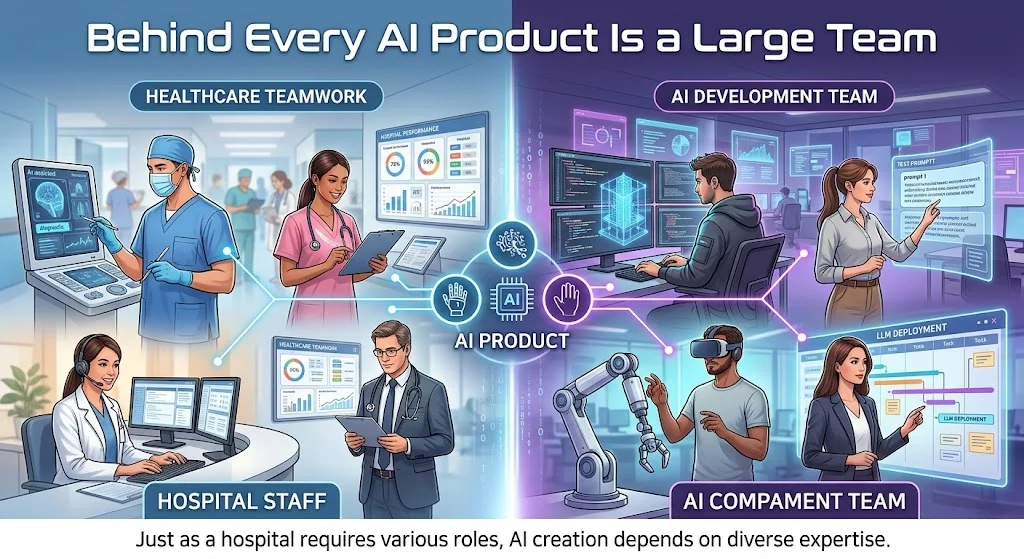
While that person exists, they are just a small part of the workforce that keeps AI working. Think of it like this; a surgeon works at a hospital, but there are plenty of other employees at the hospital never seen when the publicity goes out — people that keep the hospital functioning such as: Administer, nurse, receptionist, and HR staff as well as/ or Manager.
AI is no different; here is who works behind every product you have ever used with AI:
- Someone decided what the AI could and couldn’t do
- Someone managed the timeline and kept the project team on track
- Someone wrote, and tested all of the prompt so the AI would respond appropriately
- Someone labeled thousands of examples of data for each to learn from.
- Someone interpreted what each AI output (return of information) means to business leaders so they could understand it.
- Someone developed the training content to help train employees on using the AI application/system.
All these individuals did not require coding skills; rather, they needed to think clearly and communicate effectively in addition to having an understanding of the area they worked in. The next step is to address an issue that many career-related websites tend to overlook
The AI Roles You Can Actually Get Without Coding
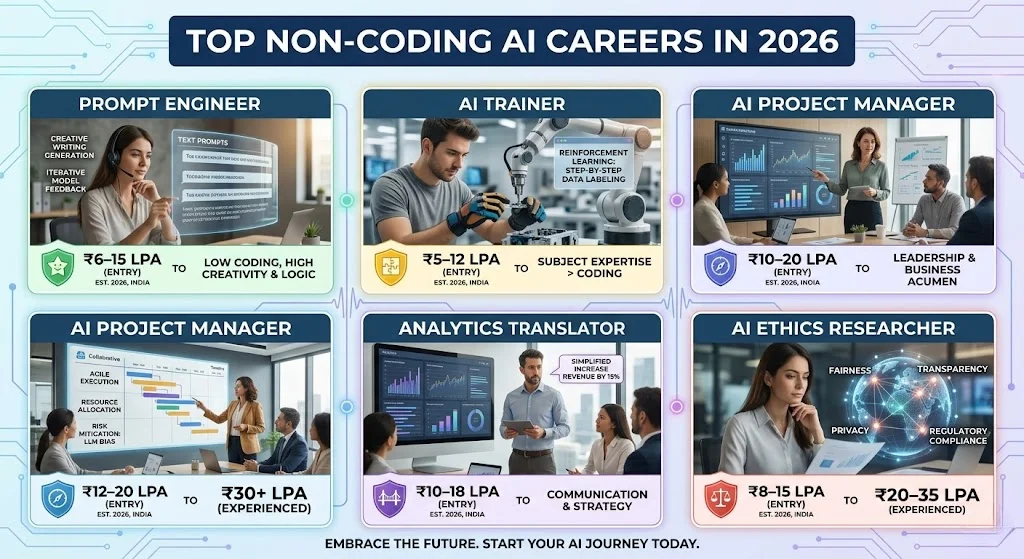
Let’s take an in-depth look at the most accessible roles. This includes covering more than just the title of the position but also what a typical day looks like and who tends to excel in this position
AI Trainer / Data Annotation Specialist
AI Trainers/Data Annotation specialists review AI output in order to help AI to develop understanding of what is accurate. So you’ll be responsible for providing examples of what “incorrect” or “biased” AI output are and how to provide additional examples for ‘accurate’ AI output. You’ll be essentially the quality control layer between raw input data and an AI model.
The role seems simple enough however, good people for the position of Data Annotations Specialist (or Data Labeling Specialist) have deep domain knowledge e.g., a doctor reviewing medical AI output, a solicitor reviewing legal output or a teacher reviewing educational content. Domain knowledge is considered rare and very useful!
Starting expected salary: $45,000 to $65,000 CAD. Specialist with Domain knowledge can earn much more
Add Your Heading Text Here
Many are surprised to learn that prompt engineering is about writing clear, concise prompts or instructions to get AI systems to produce the best results. Companies with AI in their business are scrambling for employees who can use this skill set, which focuses on clear thinking, good writing and an understanding of how prompts will be interpreted — not a technical skill but rather a communication skill.
Salary expected: $60,000 to $90,000 CAD — Senior prompt engineers at larger companies can earn significantly more than those amounts.
AI Project Manager
AI projects are projects. They have budgets; they have deadlines; they have different people — stakeholders — who don’t agree with each other, and they have deliverables that must actually ship. The role of an AI project manager is to ensure all of that happens.
If you have spent years managing projects, teams, and/or operations, the transition from your current career into this role will not be as drastic as you expect. The basics of project management will remain essentially the same with AI as they were in your current career.
Salary expected: $75,000 to $110,000 CAD. AI project management represents one of the best entry points for experienced professionals who are not technically inclined.
Analytics Translator
To illustrate this, let’s say a company had a team of Data Scientists working for three months on building a model for predicting customer churn (leaving the company) at an accuracy of 87%. When the company’s CEO walks in the room, they could then ask, “What does that mean for our revenue next quarter?” All the Data Scientists would simply stare at their laptops — someone has to bridge the gap.
This person is called an Analytics Translator. Their job is not to build the models but they do understand the outputs of the models enough to help the company make decisions and take action. McKinsey estimates that the demand for this particular role could reach approximately 2 – 4 million in North America alone.
The average salary for an Analytics Translator is approximately $70,000 – $100,000 CAD.
AI Ethics Researcher
With AI systems making decisions (hiring, loans, medical) that impact people, someone needs to ask these difficult questions – Is it fair? Where is there bias? What happens if it’s wrong?
This career path typically hires from those studying philosophy, law, sociology, psychology etc., who are able to think rigorously and write clearly. All of the major consulting firms and the UK safety institute are currently hiring for these types of roles.
Salary for an AI Ethics Researcher ranges from $65,000 to $95,000 CAD.
The Skills You Actually Need (Hint: You Probably Have Them)
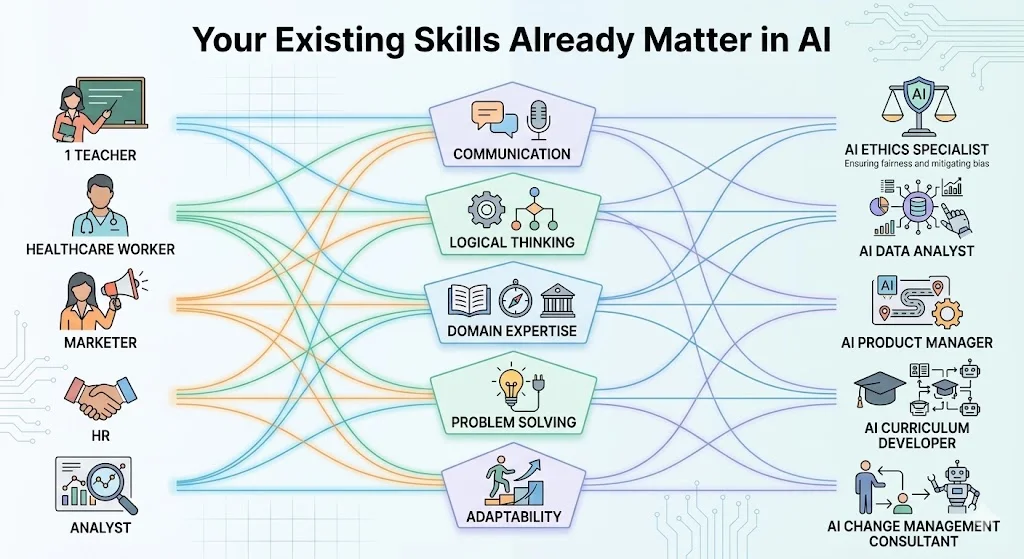
The biggest shock of this discussion for people seems to be what we’ve just discussed here.
The most important skills required to work in an AI-related (non-technical) role are not necessarily new skills; they are actually the same skills that already exist in other fields such as operations, healthcare, education, finance, etc. People have been using these skills unconsciously all along, but they never realised how useful those skills would become to them one day!
| Skill | Why AI Needs It | Who Already Has It |
| Clear written communication | Prompts, documentation, reporting | Writers, marketers, teachers, PMs |
| Logical, structured thinking | Designing instructions, catching errors | Lawyers, analysts, engineers |
| Sharp attention to detail | Data labeling, quality review | Editors, auditors, administrators |
| Domain expertise | Specialised AI training and validation | Healthcare, finance, legal, education |
| Stakeholder management | Running AI projects, getting buy-in | Project managers, consultants |
| Ethical reasoning | AI safety, compliance, bias detection | Social scientists, HR professionals |
The only new skill you will need – no matter what AI roles you’re applying for – is AI literacy. Not coding, not math – just a good working knowledge of how AI systems work, how they may not be able to replace humans completely, and how we can work with AI. That is something you can learn quickly.
Your Background Isn't a Problem — It's Actually the Point
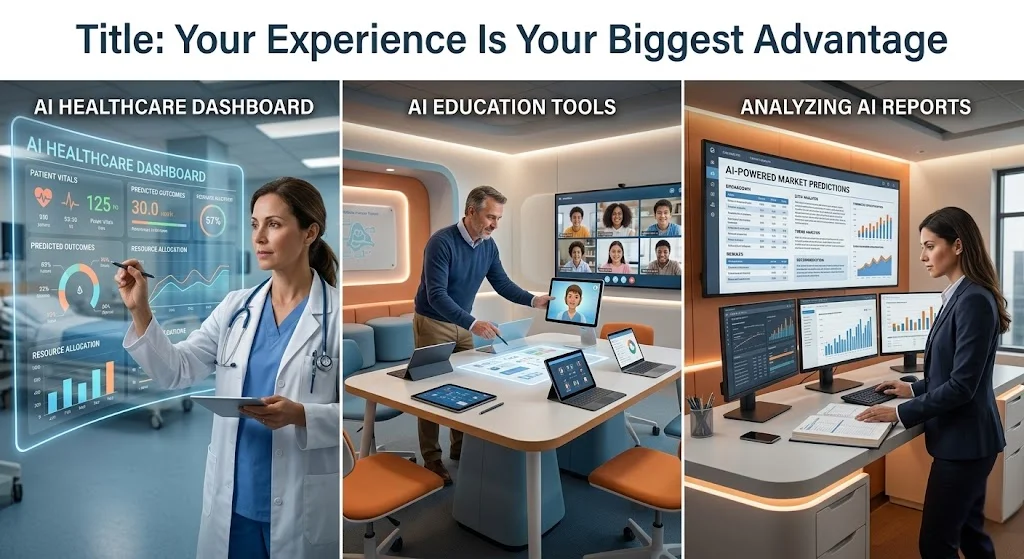
I want to clearly communicate that many companies that utilize AI will be surprised by the problems they face as a result of not understanding their own business problems.
A hospital was able to create an AI solution for a patient triage system, but after testing within their facility was successful at an artificial level, they couldn’t manage the demand for treatment based on the needs of the patients and thus had test results that were very different than what they expected. A retail company developed a demand forecasting solution that did not consider cultural differences in their various markets, ultimately leading to poor results and loss of sales.
The core takeaway here is that as AI becomes more commonplace, individuals with combined knowledge in both the respective domain and AI will be extremely sought-after in the job market in 2026. You already possess the first part of the equation. |
Your experience in whatever profession you’ve previously worked in does not constitute luggage; it’s context that AI teams really need because most AI teams have no context for the AI models they are developing. A nurse moving to AI Health gives an understanding of clinical practice that cannot be taught through an engineering program. Likewise, a teacher moving into AI Education has an understanding of how students learn, that cannot be determined by a language model alone.
You did not arrive at your new career later than many, but you will be bringing with you a perspective that is not available to engineers.
A Realistic Roadmap — 3 Steps, No Drama
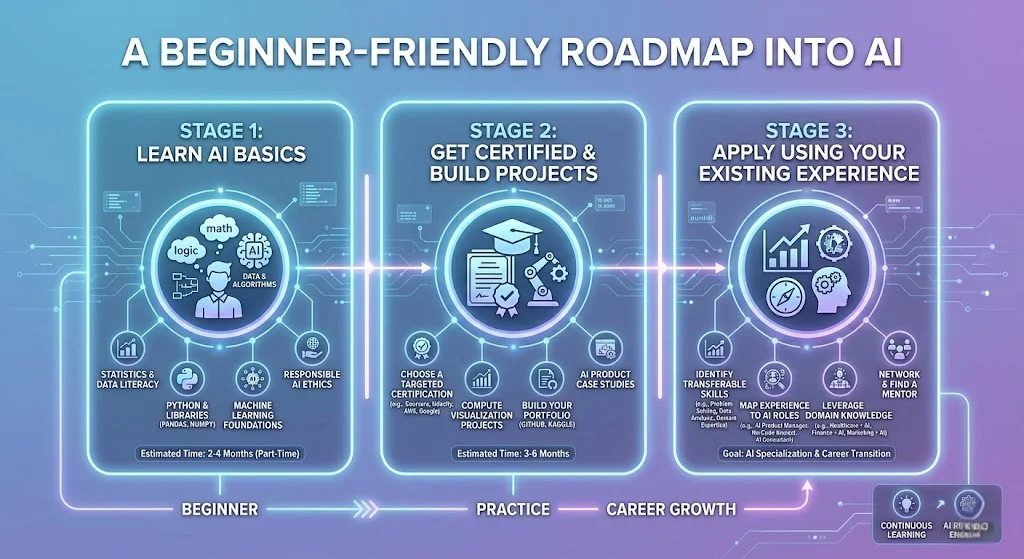
Many times people make the change worse than it needs to be. You can stay working but have time to work on a new role by not quitting or going back to school for three years to learn something new or moving to San Francisco. This is how the most successful people from an industry that isn’t technical have switched over.
Step 1: Building AI Knowledge base (First Four Weeks of Curriculum)
Building basic vocabulary, concepts will allow you to have intelligent conversations with others regarding these topics, develop intuitive questions to ask about your output from using any current-day A.I.-powered systems.
- Daily use of A.I. tools should include also observing how other people use these tools & the problems associated with people using these tools.
- Read One article every day relating to technology & A.I. providing a Full Perspective. (Suggestions: MIT Tech Review, Wired, etc.)
- Complete a course New or Existing, using Internet resources with no previous knowledge required, which should provide Beginner level education regarding A.I.
Step 2: Get Your AI Cert and Make Something
Employers can’t evaluate a person by what they don’t see on an Application and by evaluating “Potential.” Therefore, a recognized Certification makes your application credible, and a portfolio supports all Certifications.
- Complete an AI Training program that is recognized around the world and will have a Certification.
- Create 1 to 2 Portfolio pieces to be used as a result of completing the AI Train. Examples are creating an AI Workflow, creating a common prompt library for the industry to work with, or creating a mini report on how AI is affecting your current industry.
- Immediately Update Your LinkedIn Profile to include your Cert, new AI Skill and new/new AI Project Work.
Step 3 - Use Your Experience as an Asset (Weeks 10-16)
Many individuals make the mistake of attempting to obfuscate their non-tech experience in their job applications. Instead, emphasize the fact you have this experience and point it out upfront.
- Target position at the convergence of AI and your previous occupation: Eg. AI in healthcare if you are from healthcare, AI in finance if you are from finance
- Your cover letter should outline how your existing domain expertise added to your recent AI training makes you the perfect candidate for the position.
- Locate companies in your present industry that have integrated AI into their operations. Your proven knowledge of this sector will provide a unique advantage over other applicants.
Realistically: It is not uncommon for a non-technical practitioner to secure his or her first AI-related opportunity within 4 – 6 months after commencing formal, structured learning. Structured training is the key – simply teaching yourself via Youtube videos alone will rarely result in obtaining employment. |
Choosing the Right AI Course When You Have No Tech Background

This is an extremely valuable topic. There are literally hundreds of courses available for AI out there, and most of the courses available today are created for those who have some technical knowledge or background. When you throw somebody into one of these beginner AI courses, it ends up being frustrating, confusing, wasting months of their life and generally a bad experience.
Here is what to look for in an AI course designed for beginners:
- Starts from ground zero with no prior knowledge of coding or statistics or any previous tech experience
- Has live instructor-led classes and not just a bunch of pre-recorded lectures to watch
- Offers hands-on projects to work on with real AI tools (not just theoretical and quizzes)
- A certification that will be recognized by most employers and has been verified and is credible
- Assist with job placement (resume help, mock interviews, optimizing LinkedIn profile, and actually help you find a job)
- Small class size, meaning not just one of 10,000 students watching a pre-recorded lecture alone
Our AI Training Course at Proleed Academy targets professionals from Non-Technical Careers who wish to transition into AI without having to start from ground zero. This course includes coverage of AI Fundamentals, Large Language Model Building, Designing Effective Prompts, AI Tools in Today’s Workplace, and Examples of Real Life Applications of AI. Additionally, we have Live Classes Taught by Instructors who are Working in the Industry, and Certification which is Globally Recognized.
Not sure yet? Book a free demo class at proleed.academy — experience the training before you commit a single rupee. No sales pressure, no obligation. Just see if it’s a fit. |
Let's Kill Some Myths
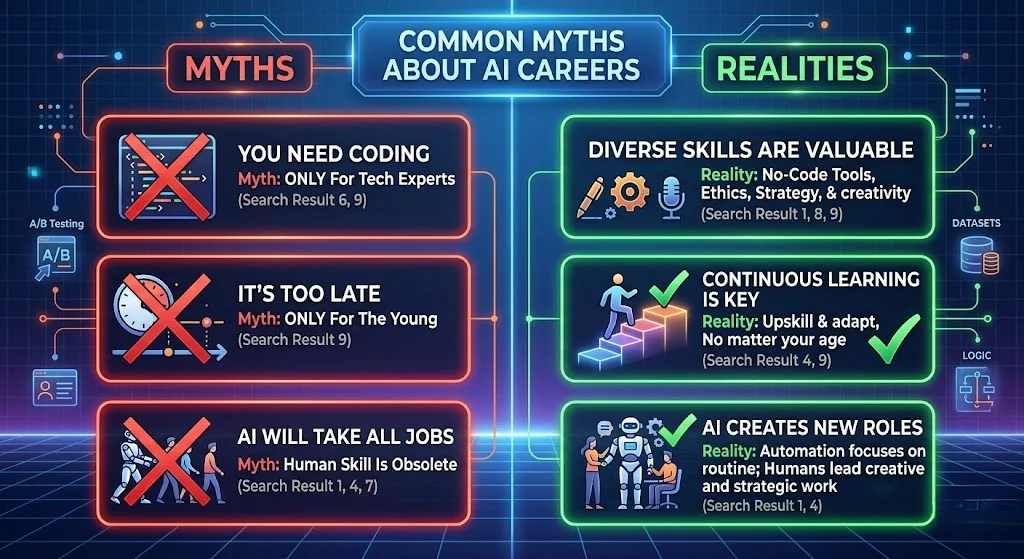
Myth 1: “To work in AI, you must have a degree in computer science."
FALSE. The vast majority of non-technical roles in AI — including project management, prompt engineering, data annotation, ethics — are recruiting from non-computer science candidates. What matters is not your degree but rather your training and mindset.
Myth 2: “To work in AI, you must know advanced mathematics."
FALSE for most roles. Statistics and linear algebra are needed by machine learning engineers; however, prompt engineers, AI trainers, and project managers don’t need it. If you aren’t going to be building models, you won’t need to know how to do the math behind the models.
Myth 3: "AI jobs will be eliminated quickly due to the development of AI"
This statement is incorrect. The use of AI will require increased human supervision, training, management and ethics throughout the deployment process. Rather than eliminating jobs for those who understand how to use AI, it is actually creating jobs for those individuals
Myth 4: "It is too late to enter the field of AI"
The 2026 AI job market still reflects the initial stages of growth within the field. Those individuals who begin their careers in AI now will be considered experts (or highly skilled practitioners) by 2028. If someone decides not to enter AI until next year, they will face more competition than if they entered the market today.
Myth 5: "The majority of online courses do not provide internships or actual employment"
Most self-paced video courses developed by generic, online course providers do not assist students with gaining internships or actual jobs. Structured, instructor-led training programs, with placement assistance and recognized certifications, offer greater potential to assist students in gaining both internship and job experience.
So — Should You Actually Do This?

This is an honest answer to the question, not a motivational poster.
If you’re sitting at a job that appears stagnant while you see the world change in response to AI, you’re wondering if a future exists for you that incorporates AI vs being replaced by it; you should pursue this.
It’s not that there’s a guaranteed gold rush from AI; and it’s not that every person who does something other than being technical will get rich by taking a course in AI; and it’s not that everyone is going to get a job that pays over $100,000 per year; but because there is a need for people who understand AI from the inside and can work with it, manage it, guide it and apply it to industries, and the supply of those types of people hasn’t caught up to the demand.
Your background is not a barrier to finding a way from where you presently are to where you want to be; your only barrier is a few months of structured learning and time spent around the proper people.
That’s not nothing. But it’s also not as far as you think.