Prompt-to-Product: How Generative AI Will Build Apps, Websites & Designs in 2026
Introduction
Advancements in technology happen at a rapid pace and generative AI represents the centre of this technological development. The ‘Prompt to product’ is an example of how AI will not only support businesses but also create real and effective products. Having worked with various tools based on AI, it is now possible to go from idea to product in hours as opposed to weeks.
Generative AI allows the creation of websites, functional apps, or complete brand identities using simple English instructions, which is exciting for students, hobbyists and emerging creators that may not yet have a coding background but have creative concepts they want to execute.
To gain a comprehensive understanding in this space, taking a generative AI training course offers learners that insight by providing an overview of how to use generative AI through code and its principles to allow for better and more productive product development in 2026 and beyond.
What Exactly Is Generative AI?
Simple Definition
Generative artificial intelligence refers to a specific kind of algorithm that creates new content through a creative process, such as graphic design or video editing. While generative AI produces original content based upon input or instructions given by users, traditional artificial intelligence utilizes statistical techniques for predictive analysis from historical datasets.
How Generative AI Is Different from Traditional AI
Generative AI builds out completely novel ideas or concepts, as opposed to Traditional AI which only finds patterns in previously created data and makes recommendations on what to do with that data. Examples of the types of tasks that Generative AI can perform include designing a new website or writing a program that will automatically execute a specific workflow. Additionally, Generative AI has the ability to create a unique logo for a business without the need for a human being to write any programming code.
In essence:
- Traditional AI understands and predicts.
- Generative AI creates and executes.
Types of Generative AI in Product Development
Generative AI can be used for different types of product development:
– Text – for documentation, UX writing and content planning.
– Code – to develop applications, code back-end processes and create Application Programming Interfaces (APIs), as well as to perform automated testing.
– Media – to design and create brand graphics and create videos.
– Synthetic Data – to create test data and simulate user behaviour.
A Transition from Outputs to Products
The advancement of Generative AI has progressed rapidly since its introduction into product development.
2023 to 2024: AI generated mostly preliminary drafts of content or small snippets of code.
2025: AI produced mock-ups and prototype versions of UI Kits.
2026 onwards: AI will be able to create entire production-ready applications and websites with complete design systems; this means that the process of transforming Prompt (input) to Product (output) will finally be possible!
The Core Transformation: Prompt-to-Product Systems
Understanding Generative AI first allows us to dive deeper into the concept of Prompt-to-Product. This is where the essence of this blog is found, where we explain how AI will create apps, websites and other forms of design in the year 2026.
What Are Prompt-to-Product Systems?
Prompt-to-Product Systems are artificial intelligence applications that create products based on straightforward instructions or prompts. There is no requirement for you to be able to code, use advanced design software, or complete the steps to deploy your end product. For a simple direction or prompt to provide the AI system with guidance or example of what to assist you, use an easy sentence or statement to indicate what is being asked.
An example would be:
- A shopping cart and a checkout area for the e-commerce website, and at least three product page designs.
- A mobile application to manage your tasks, along with alerts and reminders for each task.
- “Create a new colour brand identity for an education startup with a logo, colour palette, and font choice.”
AI programs understand your instructions, will create an optimal solution for you, and will output something you can quickly implement.
How AI Will Build Products End-to-End
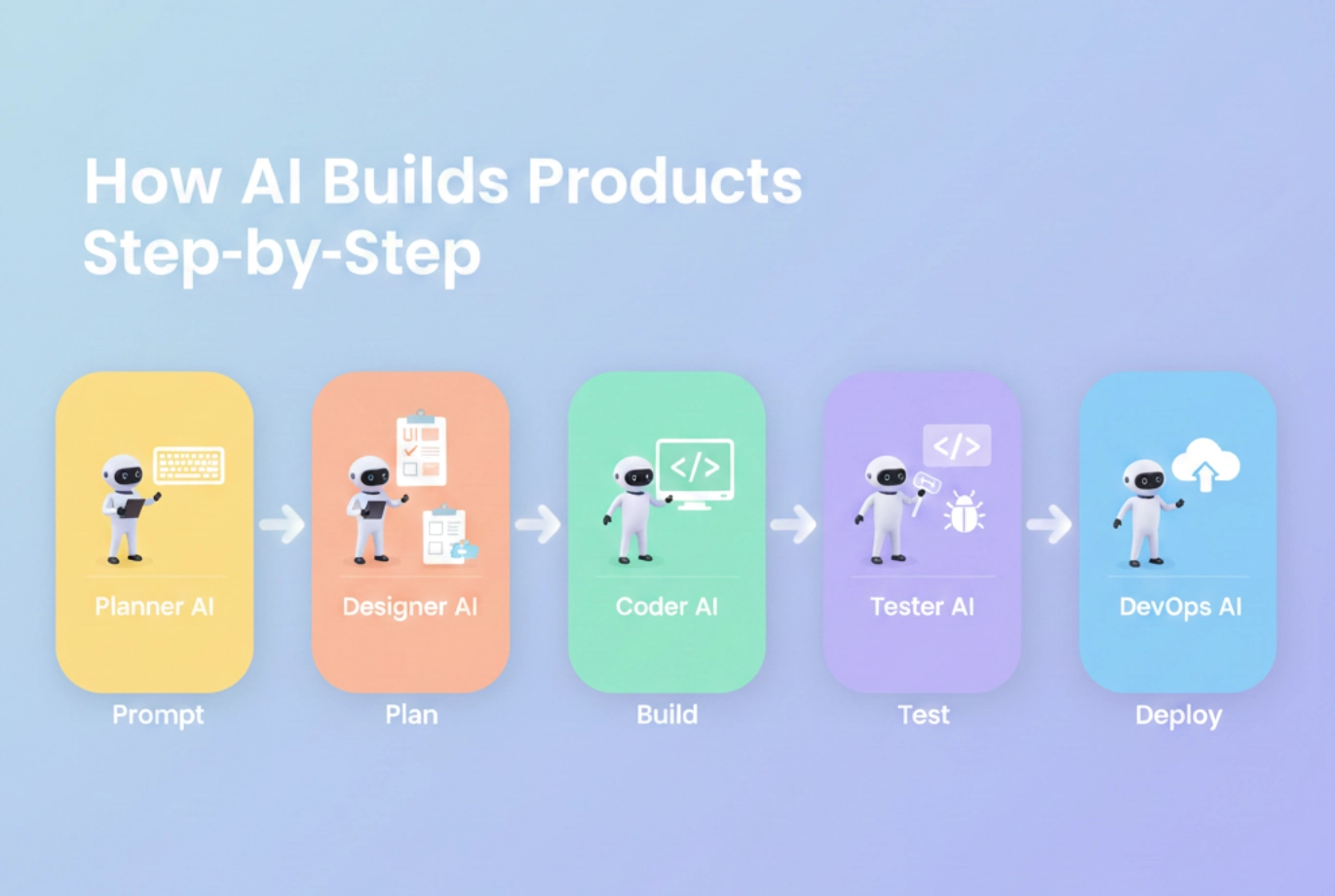
Based on my work experience using AI tools, I can summarize the entire use-case as follows:
- Interpret Prompt – AI interprets your prompt and determines the components to include in response to the prompt.
- Create a Plan – AI generates a logical plan for the product, e.g., what features the app has or what pages the website will be designed to contain.
- Generate Code / UI – AI generates code for an app or website and as well as UI design for screens or web pages.
- Deliver Product – The generated product would then be packaged/deployed or delivered to the end-user as downloadable assets.
A number of AI platforms utilize a multi-agent collaboration approach. In this method of working, separate AI agents are used to manage planning, code generation, design, testing, and deployment processes for an AI product. For example, while one AI agent may produce the app wireframe/backend, another AI agent verifies that the app UI matches the branding of the app.
Students and new users may benefit from being part of an Artificial Intelligence Master Program to learn the entire workflow of using an AI tool including how to effectively structure an AI prompt, validate AI-generated output and generate products using AI tools in real-world environments.
How They Will Build in 2026
In 2026, AI Will Be Able to Generate:
- Applications: back-end design logic and database integration, and create/deploy APIs and testing scripts
- Websites: create responsive layouts, content, search engine optimization (SEO), and hosting
- Designs: create user experience (UI) kits, branding kits/graphics, and motion graphics.
I personally did a test where AI generated a working prototype for a website in under 2 hours using 1 simple descriptive prompt provided to AI. The generated prototype featured navigation, product pages, and an actual working mobile layout for the site — tasks that typically take weeks for any designer and developer to accomplish together!
Why This Is a Breakthrough, Not Just Automation
Prompt-to-Product enables users to create products from prompts in a timely and efficient manner – in other words, it facilitates a new way of working:
- No Skills Required – You don’t need to know anything about technology to create products.
- An AI Ecosystem – There are AI agents working together to create apps, websites, and designs.
- From Hiring to Orchestrating – Businesses will no longer focus on hiring talent; they will instead focus on providing vision and guidelines while AI automates the production of the work.
Example of a micro-workflow:
- The prompt: “Create a mobile app to track student homework.”
- AI produces the database architecture, back-end API, and user interface.
- The AI tests the app’s functionality, checks that notifications are working, and outputs a production-ready codebase.
- Humans review the app and modify the branding and the colors as needed.
From years of experience mentoring students, I can say with certainty that those students who used this process were able to take their products from idea to production in a matter of hours instead of weeks. Therefore, Prompt-to-Product is a new paradigm of productivity.
Industry Impact: Who Will Be Changed & How
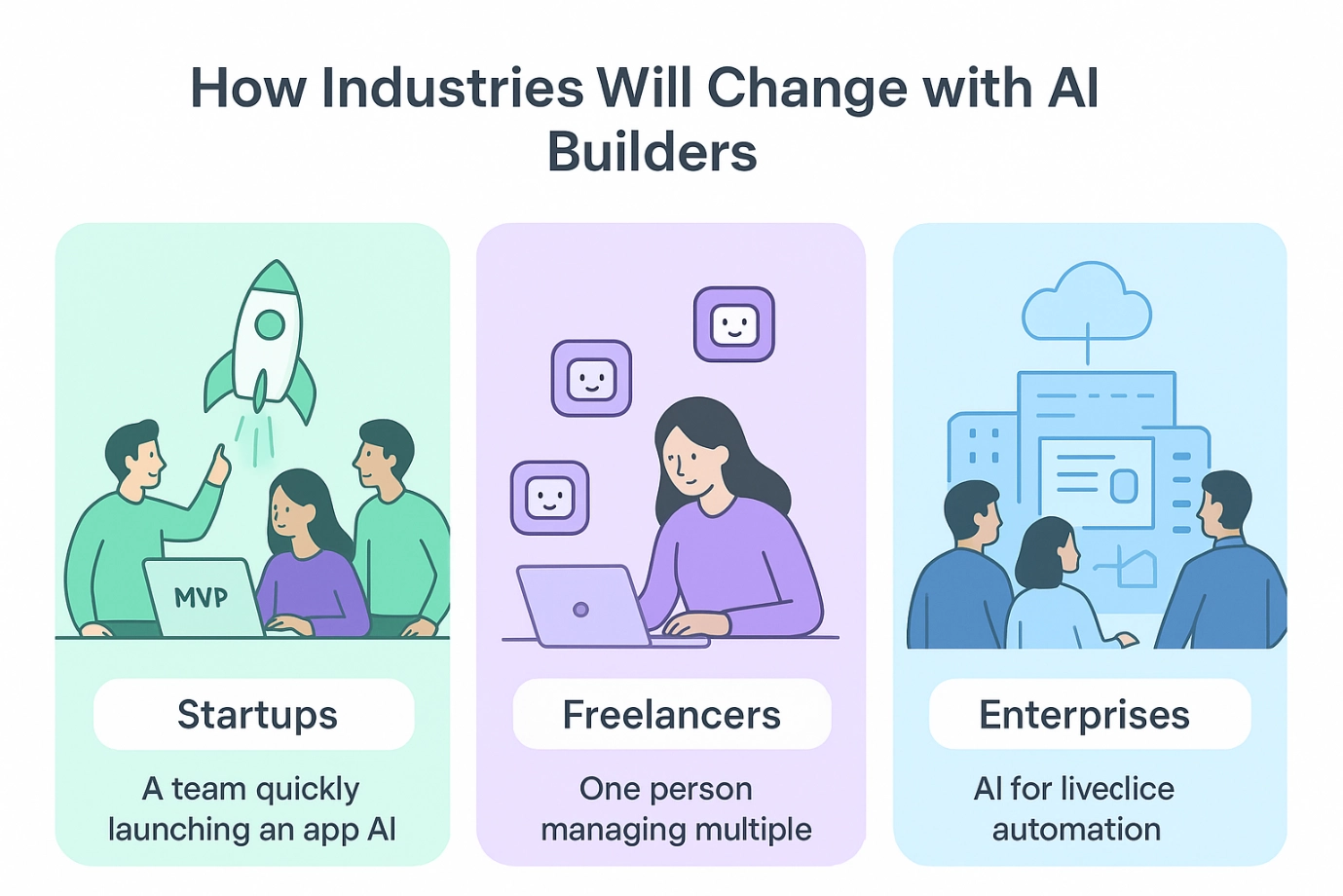
- Startups: It is now possible to build a minimum viable product (MVP) in under an hour compared to weeks. For startups, this enables small teams of people to gather actual user feedback as they create their idea. Small teams will have a greater opportunity to get user feedback and improve their product based on actual input from users. Previously, this was only achievable by larger corporations with greater resources than typical startups.
- Agencies: Agency’s ability to leverage AI automation to streamline design processes and provide multiple client projects concurrently. Through the use of AI for repetitive design functions (ie layout, content creation, testing), Agencies allow Agencies to concentrate on creativity and strategic direction.
- Freelancers: Freelancers will be able to concentrate on orchestrating the use of AI-generated products rather than relying on their own authored output. Much of the busy work associated with coding and designing has become automated, enabling freelancers to take on more project work without extensive design or technical skills. A freelancer can now take the role of a project manager directing the output of AI-generated products.
- Enterprises: Enterprises will be able to realize significant benefits by implementing AI to develop large-scale-based product workflows. Complex internal tools and end-user websites can now be developed and updated much faster, eliminating most time delays and enabling employees to focus more on developing innovative products.
New Roles & Skills in the Prompt Era
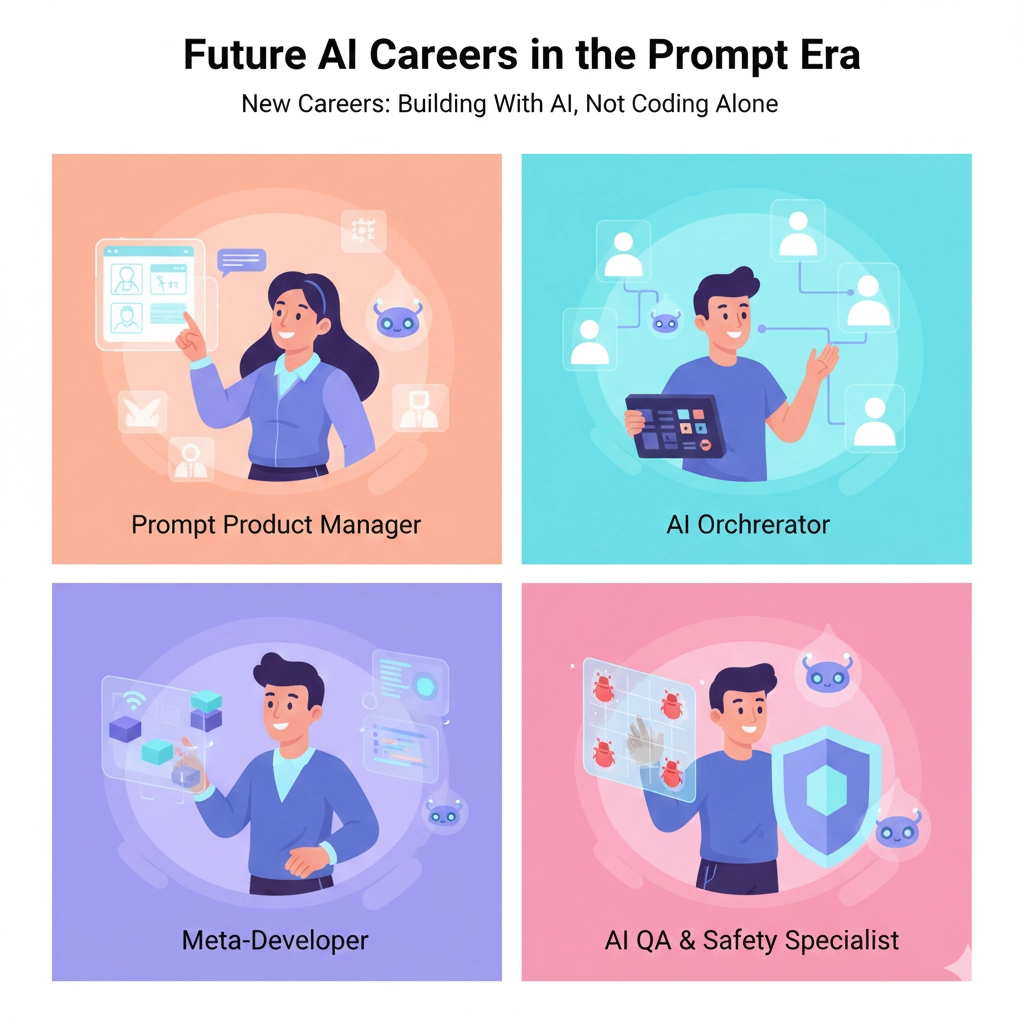
- Prompt Product Manager: Uses carefully crafted prompts to communicate with and direct an AI. They direct the AI towards a successful end product by defining the project’s vision; therefore, design and generate effective prompts are essential skills for this position.
- AI Product Orchestrator: Coordinates multiple AI agents to generate complicated product outputs simultaneously, similar to how a team leader or orchestra conductor coordinates and interacts with team members involved in the various stages (design, coding, etc.) of developing an integrated Product.
- Meta-Developer: Develops and refines the AI engine that lets you create other products. They continually develop and refine the tools that create other products, allowing for increased intelligence and efficiency in the whole process of producing products.
- AE QA & Safety: An AI Specialist ensures safety, function, and reliability of AI outputs through evaluation for accuracy, usability, security, and ethics prior to use, resulting in improved customer confidence in the reliability of the products produced with AI.
Practical Strategy for Adopting Prompt-to-Product Systems
- Define Constraints – Specify colours, layouts and logic for AI model outputs. Constraints are helpful for comparison to your branding and functionality. This means the AI’s outputs will resemble your brand’s expectations, making them easier to review and correct manually.
- Define Reusable Prompts – Create a prompt library for applications, websites and designs. Prompt Libraries can save time and ensure consistency in project deliverables, providing novice users with the means of achieving professional-quality outputs much faster.
- Choose the AI Build Tools – Use either an open-source or cloud-based AI build tool, depending on your need. The choice of the correct tools allows you to have scalable, flexible and integrated with related tools while helping the student become familiar with the industry standard platforms.
Conclusion
Generative AI and systems that translate basic prompts into completed goods give individuals everywhere the ability to create and innovate, rather than diminishing these abilities. By 2026, anyone with an innovative thought (the initiating prompt) and a formulated prompt will have the opportunity to create application software, web pages, or design products. Individuals will assume the role of directors and visionaries, while AI takes care of the execution in a highly efficient and dependable manner.
For today’s young creators, students, and experts, becoming skilled at these methods is crucial for future success, and there are many learning opportunities available via resources such as Generative AI Training Programs, or an AI Master Program.
In the future, we will collaborate with AI, and together we will generate an infinite number of creations.