
Table of contents
- How to Start an AI Career in Canada With No Experience
- Who This Guide Is For
- Why Canada Is One of the Best Places to Start an AI Career Right Now
- What an AI Career Actually Looks Like - Roles, Salaries, Reality
- Step 1 — Understand Where You Are Starting From
- Step 2 — Build AI Literacy First
- Step 3 — Choose the Right Learning Path
- Step 4 — Build a Portfolio That Gets Noticed
- Step 5 — Apply Strategically, Not Broadly
- The Most Common Mistakes People Make Starting an AI Career
- Frequently Asked Questions
How to Start an AI Career in Canada With No Experience
A Step by Step Guide for Beginners and Working Professionals

Who This Guide Is For
This page is tailored to two types of users: Firstly, complete novices who don’t have an IT background, have no coding experience, or have any idea of where to begin in this whole new field. Some examples of complete novices are nurses, teachers, marketing managers, or individuals who have spent their entire career working in operations. They have been bombarded with information about Artificial Intelligence (AI) and are now at a crossroads in their career wondering if there is a way to become involved.
Secondly, professionals with limited exposure to technology (e.g. within an organisation alongside a traditional career), such as software development, finance, data management, etc., who want to transition into the rapidly growing field of AI and have an honest view of how to get from where they are today to being part of this new wave.
This guide will contain valuable information for both novice and advanced users of AI, and there will be a lot of information in this guide, specifically tailored to your level of knowledge; therefore, you can avoid wasting time with material that was created for someone else.
Quick stat: Canada has more AI job openings than qualified people to fill them. Entry-level AI roles currently pay CAD $65,000 to $85,000 annually — and that’s before you factor in mid-career growth to $90,000 to $130,000. The gap between supply and demand is your opportunity. |
Why Canada Is One of the Best Places to Start an AI Career Right Now
Optimism is more than just belief. Canada has several structural advantages over other countries when it comes to entering into the world of artificial intelligence that simply aren’t available right now in most other places.
The Canadian government is investing billions of dollars into artificial intelligence through the Pan-Canadian AI Strategy, which supports research institutions located in Toronto (Vector Institute), Montreal (Mila) and Edmonton (Amii). Some of the largest companies in the IT industry, like Google, Microsoft, Meta and Amazon also operate AI research offices in Canada.
The talent shortage is real and will only increase in the future — many more jobs than people qualified to fill them.
| City | Importance of City in AI Career Development | Sectors Hiring |
| Toronto, Ontario | Largest Market for Jobs in AI in Canada (Banking Sector, Consulting Firms, & Vector Institute) | Banking, Finance, Consulting, Technology, Insurance |
| Montreal, Que. | Worldwide AI Research Hub (Mila, Google DeepMind, & Meta AI) | Video Gaming, Aerospace, Research, Fintech, Retail |
| Vancouver, British Columbia | Strong Biotech & Technology Ecosystems (Amazon, Microsoft, EA) | Technology, E-Commerce, Biotech, Video Gaming, Media |
| Calgary, Alberta | Lead Sector for Adoption of AI in Energy Sector (Higher Salaries & Lower competition) | Energy, AgTech, Logistics, Consulting |
| Ottawa, Ontario | Condition of Government-Subsidized Investment in AI (Stable Positions & Strong Pension Fund) | Government, Defence, Healthcare, Consulting |
| Edmonton, Alberta | Developing Market (AI Wages are Above the National Average and Less Crowded) | Energy, Utilities, Government, Agriculture |
Sources consulted: LinkedIn Jobs on the Rise Canada 2026, Glassdoor Canada June 2026, Robert Half Canada Salary Guide 2026.
The practical result? There is an active job market for artificial intelligence across all of Canada. The city you are located in may determine what industries you may choose to look for work in; however, there are opportunities available to you in each and every one of those industries.
What an AI Career Actually Looks Like - Roles, Salaries, Reality
AI isn’t just one type of job; it is a wide range of jobs: technical and non-technical, with a large number of positions that fall between those extremes. Understanding this will assist you in choosing which skills to develop and what job titles to pursue, as well as how long it will take you to get to your targeted position.
| Job Title | Skill Level | Average Salary in CAD | Best Relevant Experience |
| Prompt Engineer | No Coding Required | $60,000 – $90,000 | Writers/Marketing/Teaching/Communication |
| AI Trainer/Data Annotator | No Coding Required | $45,000 – $65,000 | Domain Expertise (Healthcare/Law/Education) |
| AI Project Manager | MED/LMED | $75,000-$110,000 | Already have project management/operations management/Consulting experience |
| Analytics Translator | MED | $70,000 – $100,000 | Business Analyst/Finance/MBA Graduate |
| AI Operations Associate | MED | $65,000 – $85,000 | Information Technology Support/Operational Professional/Recently Graduated |
| Junior ML Engineer | MED/HIGH | $70,000 -$95,000 | Recently Graduated in Computer Science/Self-Taught Programmer With Portfolio |
| ML/AI Engineer | HIGH | $90,000 – $130,000 | Software Engineer with AI Structured Education |
| AI Research Scientist | VERY HIGH | $110,000 – $160,000+ | MSc or PhD in Computer Science/Mathematics/Related Field |

Step 1 — Understand Where You Are Starting From
Make sure that you honestly assess your starting point before choosing your course of study or purchasing a course, updating your LinkedIn profile, etc. Twenty minutes spent honestly assessing your starting point will set you up for everything else going forward
If you are a complete beginner with no IT background
If you have little or no IT experience, your value is not your knowledge of AI, but your knowledge of the industry you are currently working in. For example, a nurse has clinical knowledge, a teacher has an instinct for teaching design and a retail manager knows how consumers behave. These things will be valuable in a company building AI systems for those industries.
The first step to learning about AI is becoming “AI literate”, or understanding how AI systems conceptually work/how to describe AI technology generally, before you dive into any technical tools. Most times, novice users tend to bypass this step, and this is by far the most prevalent mistake made by novice users.
Are you working in the technology industry?
If so, then you likely already have some basic knowledge about SQL or basic Python analysis. Whether or not you have the aptitude needed to fill an AI job in the future will depend on how well those skills align with current employer requirements for such roles; however, regardless of years spent working in tech, the likelihood of a large gap exists between your current knowledge and what is currently in demand from an AI perspective. There is a path to bridge this gap; however, you must be willing to evaluate yourself honestly.
An honest question to ask yourself is, “Which job do I want to do?” In addition, what is my current level of qualification compared to that position? Write these things down; a lack of a concrete plan is a major enemy to progress toward achieving your goals. |
Step 2 — Build AI Literacy First
machine learning. This ends up leaving people lost, with no momentum and eventually quitting.
AI literacy isn’t about memorising concepts; it’s simply about gaining a basic, working knowledge of how an AI system is designed, what an AI system can do and what it cannot do, and how it may be applied in the real world. After you have established that mental structure or framework, you will have a better understanding of everything else (technical skills/skills/tools/frameworks).
Here’s how AI literacy looks in practice:
- Learning what machine learning means beyond a text book definition is conceptually; it involves teaching systems through example, where Uber Eats uses machine learning to predict delivery time based on past data of deliveries.
- Learning what large language models (LLM’s) like ChatGPT, Claude & Gemini do; they have been built using vast amounts of text and are able to predict the next most likely word based on the content of the previous words. The prediction is made at a massive scale and can produce meaningful responses which appear to indicate a greater understanding of a subject than is actually the case.
- Learning the difference between narrow AI (the type of AI that is used will be job-specific) and general AI (AI that can perform human-level cognitive abilities) – general AI does not exist yet no matter what the press is saying.
- Understanding how AI can fail; through hallucination, bias, data drift or via adversary input; understanding where systems fail is as useful to knowledge base as knowing their capabilities; it’s the difference between an applicant who read about AI and someone who understands AI.
Deliberate study (reading/experimenting with AI tools/asking good questions) for 2-4 weeks typically establishes a great foundation for AI literacy. It’s not very long, but skipping out on this foundational study makes later learning much more difficult.

Step 3 — Choose the Right Learning Path
Deciding and learning is the issue. Let’s simplify that for you.
Your two options are self-study or an organized course. Both options work well, but have very different amounts of time needed to complete, more than double the rate of participants dropping out, and have significantly different results after graduation.
| Self-Study | Structured Training | |
| Cost | Low to no cost (free) | Cost of course fees |
| Timeline to job readiness | Usually 12 – 24 months | Usually 6 – 9 months |
| Dropout rate | High – No accountability | Low – Benefits of Structure |
| Curriculum Quality | Inconsistent – Difficult to curate | Consistent – Well designed and professional |
| Skills 5 – 7 (e.g., RAG, Agentic and Deploy) | Hard to learn alone | Easier to learn (guided projects provided) |
| Finding out if the practice is done correctly | ZERO feedback (you’ll never know) | Provides you with ongoing feedback from an instructor |
| Best for | Highly self-motivated, already technical | Most professionals and beginners |
Self-studying is possible; however, AI is an industry where going in the wrong direction could cost you 1 or more months before you realize that you are going in the wrong direction, and then realize when you finally interview, that you missed a lot.
Structured instructor lead training such as the Proleed Academy AI Training Course to close this gap much quicker. Proleed Academy provides live sessions that have real projects assigned, instructor feedback, and teaches the skills that employers are actually hiring for right now (RSU, RAG, AI, Agentic) and how to deploy them – many self-study programs do not cover these skills sufficiently.
Step 4 — Build a Portfolio That Gets Noticed
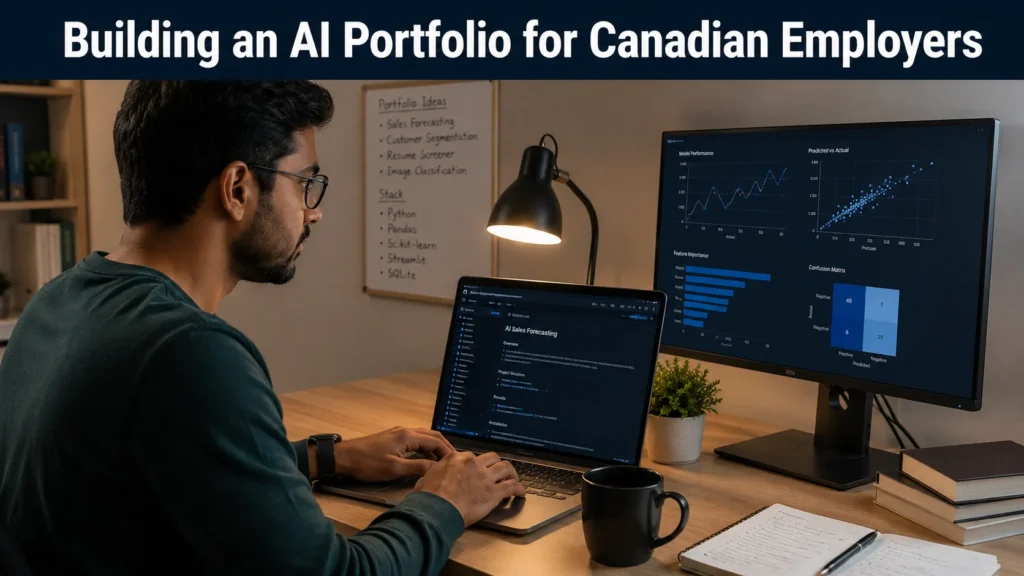
As part of the Canadian AI job market, Portfolio is more important than a resume for most of the positions. Employers want to see evidence of your ability to perform a task, not just your education.
The good news for aspiring AI professionals is that creating an excellent AI portfolio doesn’t take years of work experience; rather, it comes from completing purposeful and well-documented projects demonstrating your skill set.
When building your AI portfolio, include:
- Projects – build 2 or 3 full projects, and no tutorials. Define and solve your own problems, or if they’re very small, at least demonstrate originality in your thinking.
- Source code – have a git hub repository that contains your well-documented source code, with an appropriate README to explain what the project is/functionality/how you learned (e.g., techniques, concepts).
- Results – show the results from the item you built, as well as documenting the process you used to create it. Include performance metrics (if applicable), accuracy comparisons, and real results, along with the original code (if possible).
- Domain Knowledge – if you are looking to work in Healthcare AI-related positions, you should try to build healthcare systems or data examples. The closer your project is to the domain of interest, the more credible you will appear to your prospective employers.
How to Make Your Portfolio Hireable versus Presentable
Many portfolios created by beginners look good, but they won’t survive technical questioning due to three main differences. Real projects developed under supervision with instructor feedback, deployed models that show a candidate’s ability to deliver functionality, and a candidate’s understanding of their reason for each decision made in building the solution.
The first two items are provided directly through structured training programs, while the last item is acquired through developing a thorough understanding of your project so you can effectively defend your project in an interview.
Step 5 — Apply Strategically, Not Broadly
There are people who send out 50 identical resumes hoping to get hired — they have no job search strategy. They spend time looking busy instead of finding a job.
The professionals that get AI jobs in Canada fastest are applying fewer times and more intentionally, creating better applications.
- Focus on jobs that utilize your skills and what you have done for work, such as marketing. If you have developed skills for a specific job, like Marketing Technology, you should pursue those jobs instead of applying for a job as a Machine Learning Engineer.
- Use your expertise and experience in your cover letter as an asset; don’t hide your experience outside of the AI industry, it should be framed as a benefit to the company you are applying to.
- Apply for 5 to 10 jobs per week with tailored resumes and short cover notes specific to each of those jobs.
- Use your network to find job opportunities and apply — Use LinkedIn to connect with people in the industry, attend tech meetups in Toronto, Montreal and Vancouver, and engage with AI communities. Referrals are the best way to get an AI job than cold applications.
- Be prepared for technical interviews, even non-technical AI jobs may have a practical test as part of the interview process. Be able to explain the reason you made every decision on your portfolio projects.
The Most Common Mistakes People Make Starting an AI Career
Many will see this repeatedly. Knowing this ahead of time can save you months of effort.
Mistake #1 — You have to wait until you are fully knowledgeable before applying to any jobs
AI has been a developing field and there is never enough knowledge. If you wait to feel prepared to apply, you will not apply until the end of time. You should have 2-3 good skills and 1-2 good portfolio projects before you start looking for jobs, but please remember to begin applying as soon as possible even though you may feel too early. The interviews will teach more about what you are missing than a class ever would.
Mistake #2 — Trying to follow an out-of-date curriculum to prepare for jobs
A course created in 2022 or 2023 for AI will not refer to modern LLMs, agentic AI, or RAG systems, which are the desired qualifications by 2026. Before purchasing any course, check when it was last updated.
Mistake #3: Creating a General Portfolio of Projects
Projects created using well-known tutorials (movies review sentiment analysis, handwritten digit analysis, etc.) are useful for learning; however, they are not likely to impress interviewers since these same projects have been completed by a majority of other candidates. Consequently, try to make sure that your project is linked to the industry of the firm you want to apply to.
Mistake #4: Failure to Realize the Importance of Communication Skills
Mid-level Canadian AI companies want candidates that have technical proficiency; however, also want candidates that can explain AI-related decisions to non-technical stakeholders, manage cross-functional projects, and communicate effectively. These are all skill sets that you have build-up and do not undervalue.
Mistake #5: Self-Studying Without an Environment to Receive Feedback
When teaching yourself AI, the issue is you will never know what it is you do not know. You could spend three months learning the wrong skills and will not discover this until you are not successful in a job interview. When you take a defined and formal course with feedback from your instructor you are able to eliminate the above mentioned issues much quicker.
Frequently Asked Questions
That’s a very real possibility. There are a number of open AI jobs, including the following four roles: AI Project Manager, Prompt Engineer, Analytics Translator and AI Trainer, which are open to individuals without computer science degrees. You can be employed in these AI roles if you have an established portfolio along with structured AI training
For most people starting out in their AI careers, it takes approximately 6-9 months from the time they begin formal training until they find an entry-level position in the AI industry. In contrast, those who choose to rely on self-study have been shown to take anywhere from 12-24 months to find an entry-level position.
For new arrivals in Canada, the most accessible entry-level positions are: Prompt Engineer, AI Trainer, AI Operations Associate and AI Project Manager. All four positions currently have multiple posted job openings across Toronto, Montreal, Vancouver and Calgary. No coding experience is required for any of these positions.
No, Canadian employers are far more interested in having their employees possess practical, applicable skills and experiences; therefore having a portfolio demonstrating your skills combined with credible evidence of training will help you land the job.
Yes – if it is Instructor-Led, up to date with tools such as generative AI and Agentic Systems, and is supported by a verified Certificate. Pre-recorded video courses will have much lower value than structured live programs.
Ready to Start Your AI Career in Canada? Proleed Academy’s AI program is built for both complete beginners and working professionals. Live instructor-led sessions, real projects, globally recognised certification. Book your free demo class at proleed.academy |