Table of contents
- Introduction
- What Is an AI Agent (In Production Terms)?
- The Illusion of Success: Why Demos Work but Production Breaks
- Core Reasons Why AI Agents Fail in Production
- The Hidden Engineering Realities Most Blogs Don’t Discuss
- Why Scaling AI Agents Is Harder Than Scaling LLM APIs
- Common Architectural Mistakes
- How to Build Production-Ready AI Agents
- Case Patterns: Where AI Agents Actually Succeed
- Conclusion
- Frequently Asked Questions
Why Most AI Agents Fail in Production: Hidden Failure Patterns and Engineering Realities
Introduction
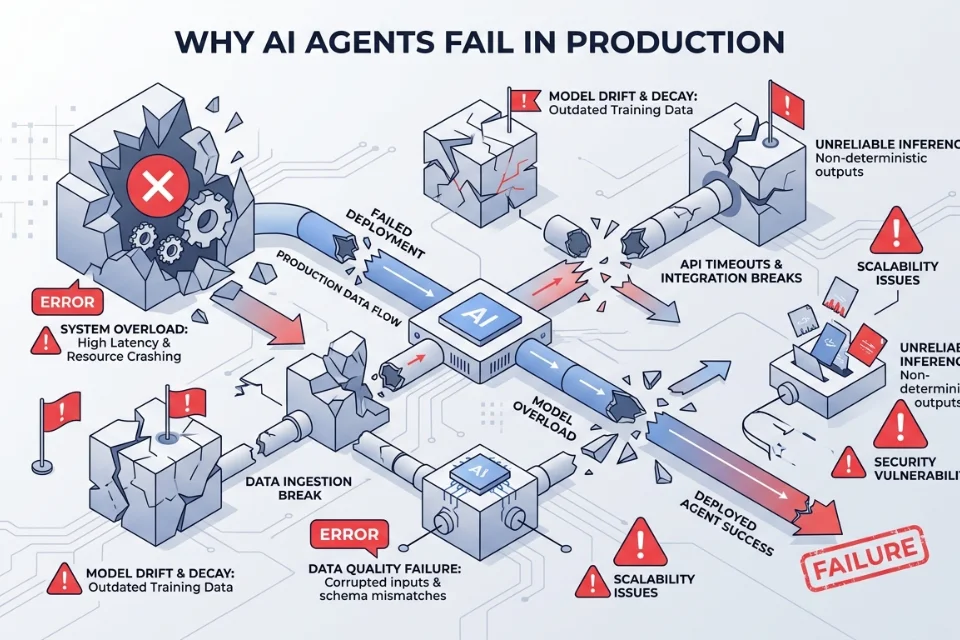
AI agents have come a long way from demo environments to deployed enterprise solutions. While they often perform flawlessly in controlled demos, many AI agents fail silently in real-world production environments.
They are shown to be capable of completing complex tasks without human intervention; successful, independent, intelligent, and reliable within controlled test environments. Once in production, however, many of these AIs will exhibit subtle and surprising failures.
The reason for the vast difference in success is largely due to the unpredictability and chaos of production environments, which expose weaknesses; demos aren’t exposing the weaknesses in the architectures used to develop the AI.
This is why Artificial Intelligence Training today includes a greater emphasis on understanding systems through a system-level perspective, increased emphasis on observability of AIs in production, and a more disciplined approach to software engineering as opposed to simply understanding how to prompt the AI to respond correctly or utilize the model associated with the AI.
What Is an AI Agent (In Production Terms)?
A smart LLM prompt is what many people think of when they hear about an AI agent, but that’s not the case in actual production where there are multiple parts making up an agent and running continuously through a cycle:
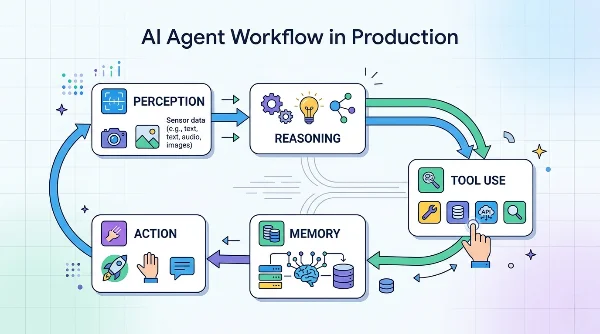
– Perception → Reasoning → Tool Use → Memory → Action
Whereas with a single API call, an agent:
- Keeps track of its state as it transitions through each of the steps in this cycle
- Uses numerous different tools and APIs (sometimes within an individual step)
- Has the ability to access and store memory and/or their state
- Makes decisions that can affect an actual system
The above differences highlight that AI agents are much more like distributed software systems and much less like chatbots.
The Illusion of Success: Why Demos Work but Production Breaks
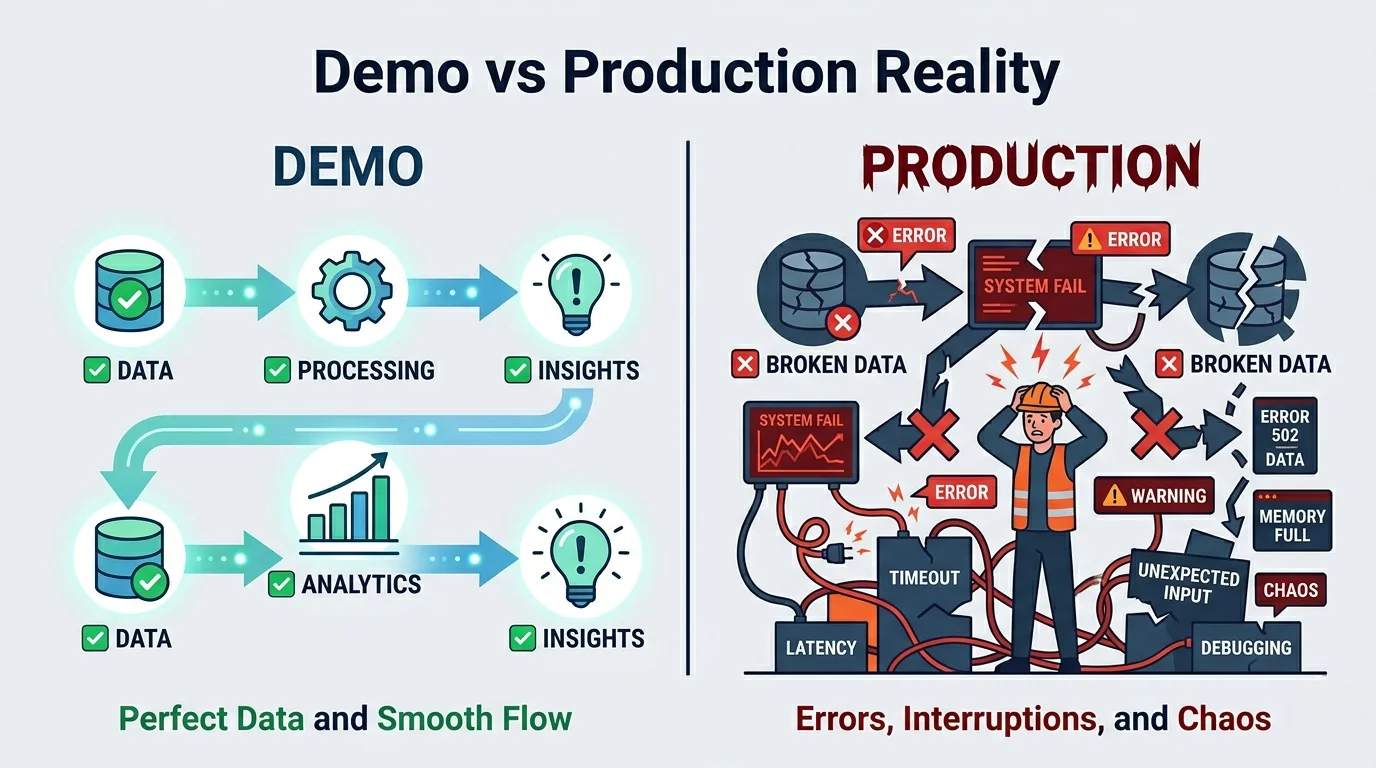
Demos work well under ideal circumstances:
- Perfect input data
- Constant interface connections
- No authorization problems
- Stable procedures
Production adds an element of unpredictability:
- Enterprise data that is not structured
- Tools breaking or timing out
- Changing authorization/permissions
- More than one step involved with other processes
Prototype design in sandbox environments will break down as they are tested in real-world scenarios.
Core Reasons Why AI Agents Fail in Production
Lack of Defined Success and Poorly Framed Problems
Many agents have been created or developed without first determining:
- What success will look like, and how that will be perceived;
- How much error will be acceptable;
- How much the agent should cost; and/or,
- How long it should take to complete a task.
Without these key performance indicators (KPIs), such as completion rate, cost per task and frequency of error, the reliability of the agent cannot be measured
Real-World Data Chaos and Data Maturity
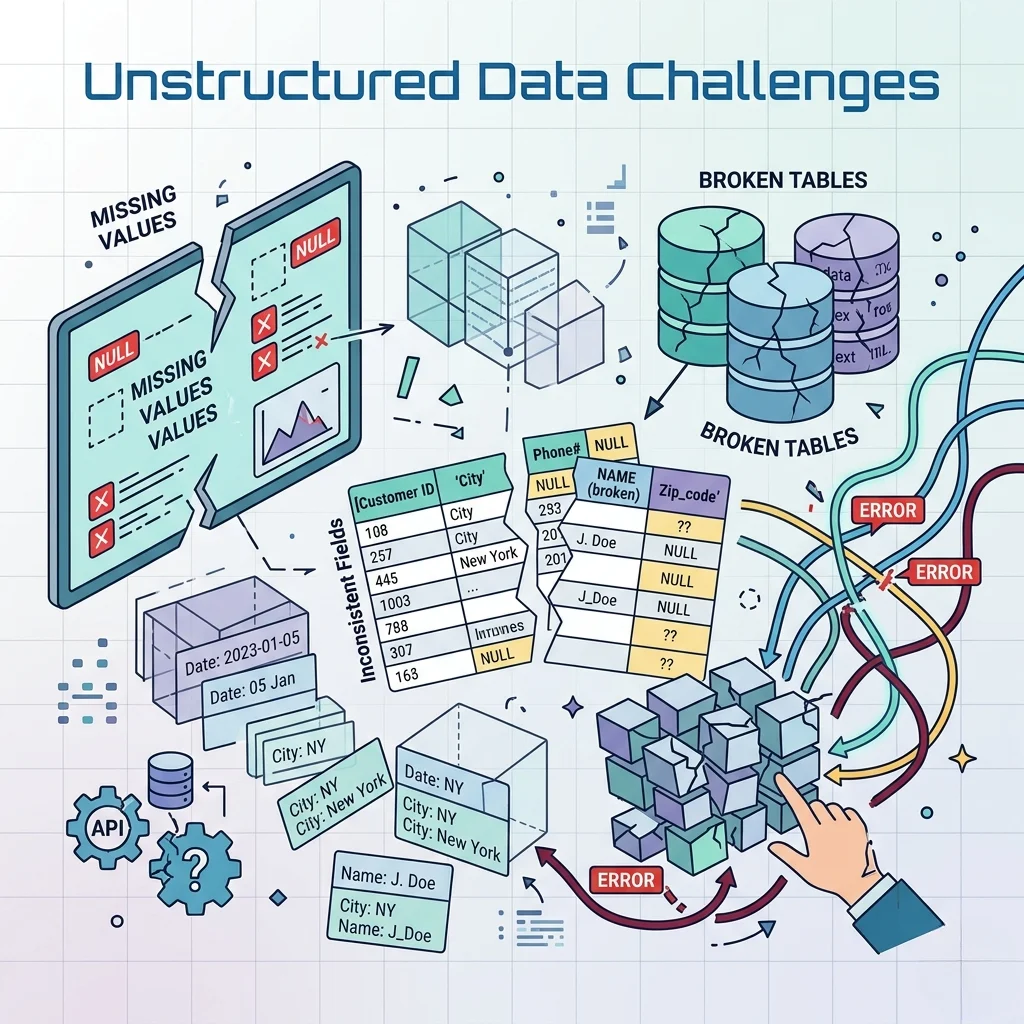
Data in enterprise environments is usually not AI-ready:
- Field / value pairs missing;
- Inconsistent formats for values;
- Inconsistent formatting between systems; and,
- Not designed for independent logical reasoning.
Agents will be unsuccessful to the extent their perception layer is unreliable.
Tool & Environment Instability
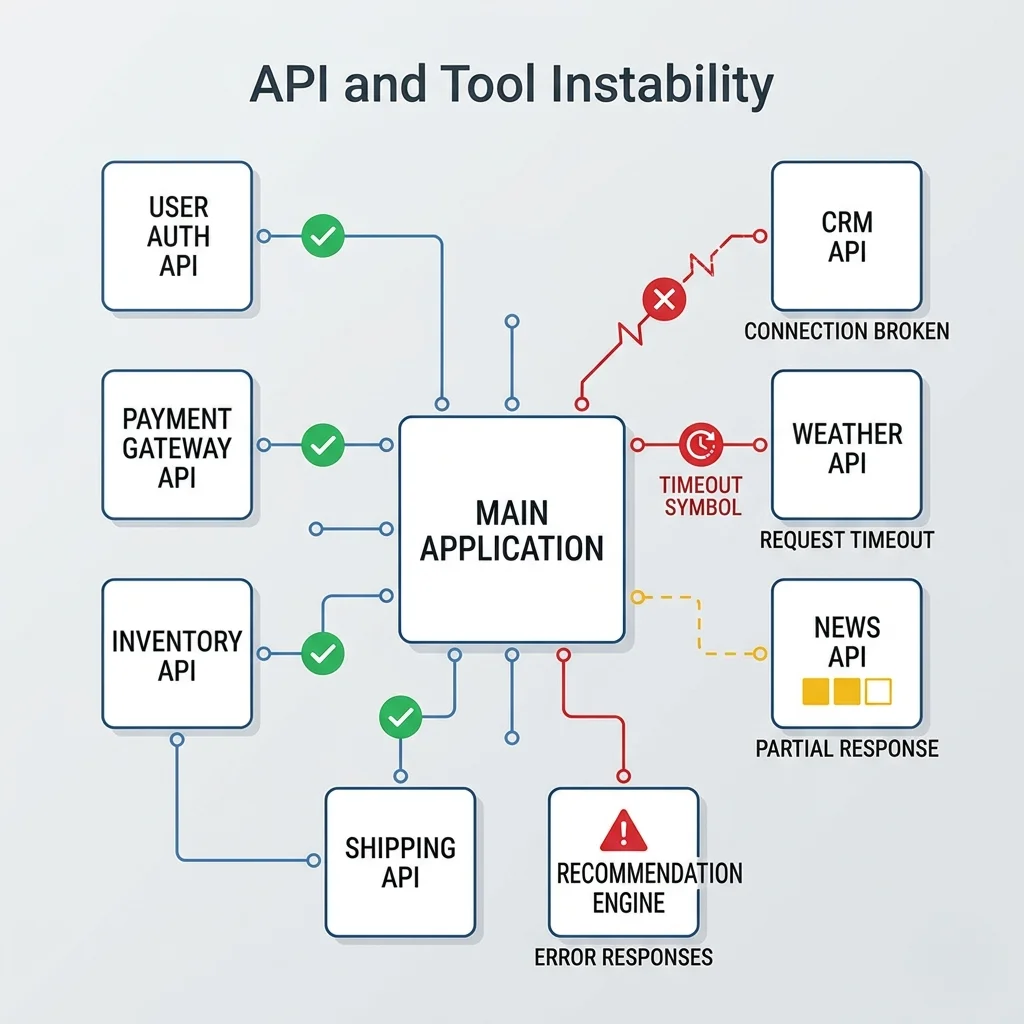
External tools are relied on by agents.
- APIs time out
- Formats of responses are not static
- Permissions can become invalid
- Partial responses may be returned by services
While the reasoning of the agent is correct, the workflow is broken by the environment.
No Deterministic Verification Layers Available
Many design use cases contain:
- Agents create and execute actions without validating them while reasoning.
- There is no validation process for the transition from reasoning (agent) to actual execution.
- Since no verification will occur, the outputs of the tools will be accepted as “correct”.
Resulting in silent and dangerous errors.
Silent Failures and Cascading Errors
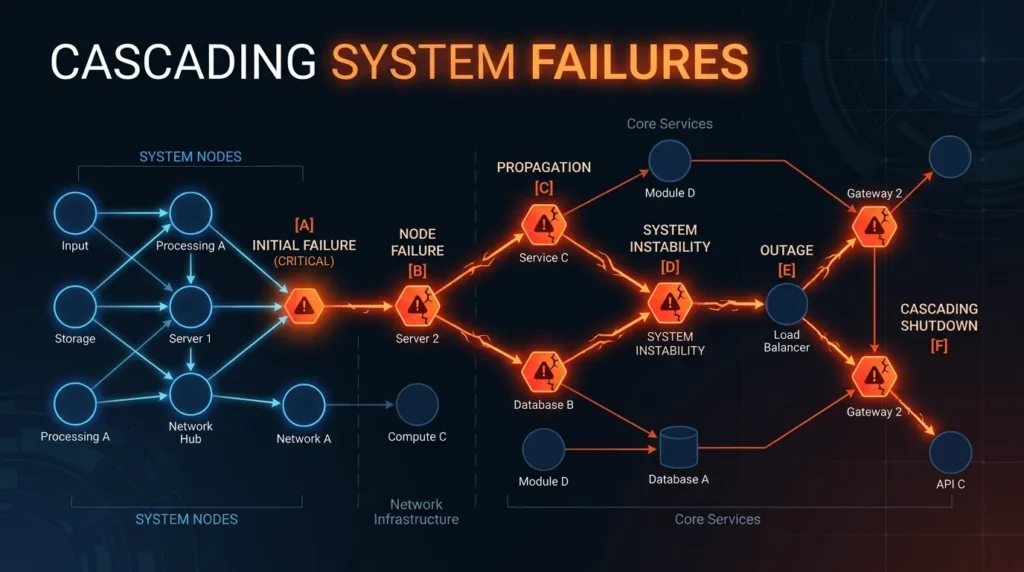
Multi-tier workflows result in:
- Corruption of context across multiple steps
- Retrying a process indefinitely
- Propagation of failure throughout the entire system
The small issues eventually add up to a complete failure of the system.
Lack of Observability & Debugging Infrastructure
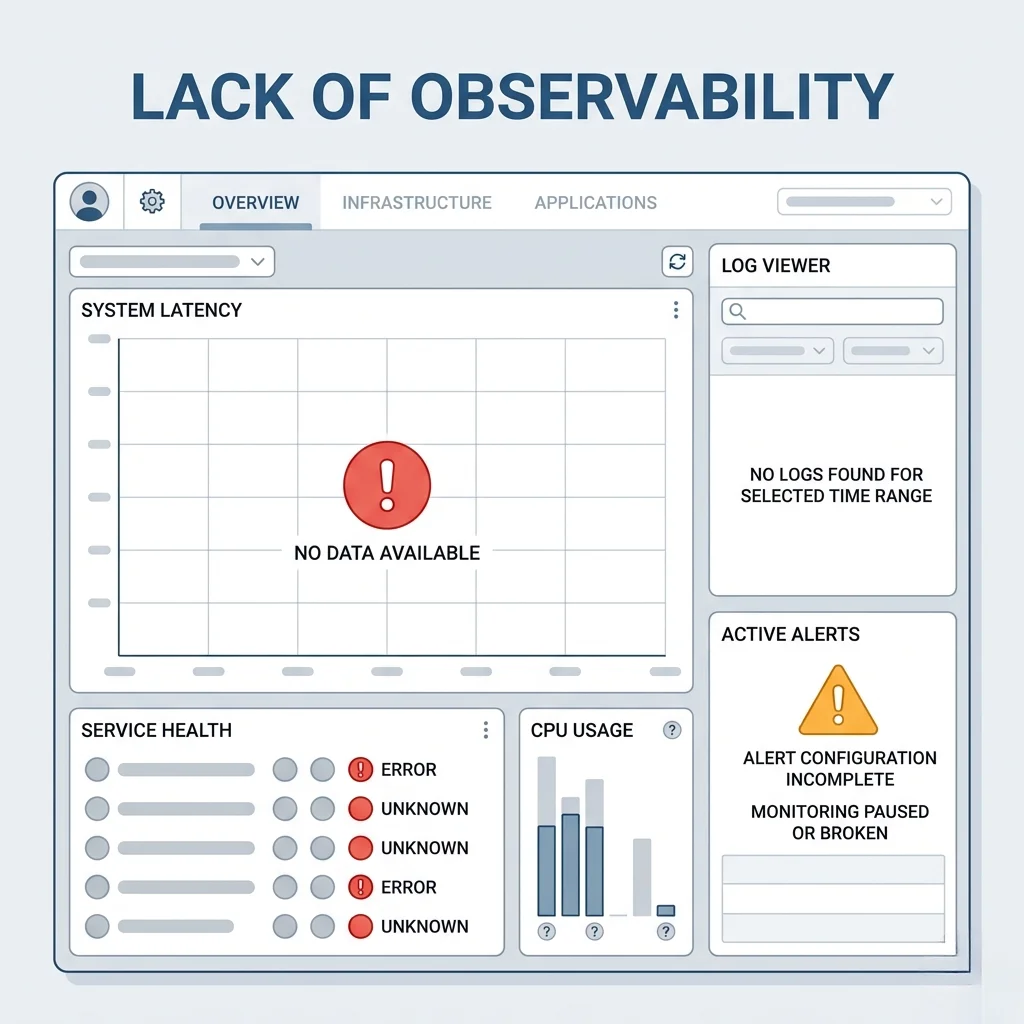
Often teams find themselves without:
- Logs for each step of the process
- Reasoning traces available for the entire event
- Alerts and monitoring for an event when it occurs
When there are failures it is difficult to identify their root cause
Over-Reliance on Autonomous Loops
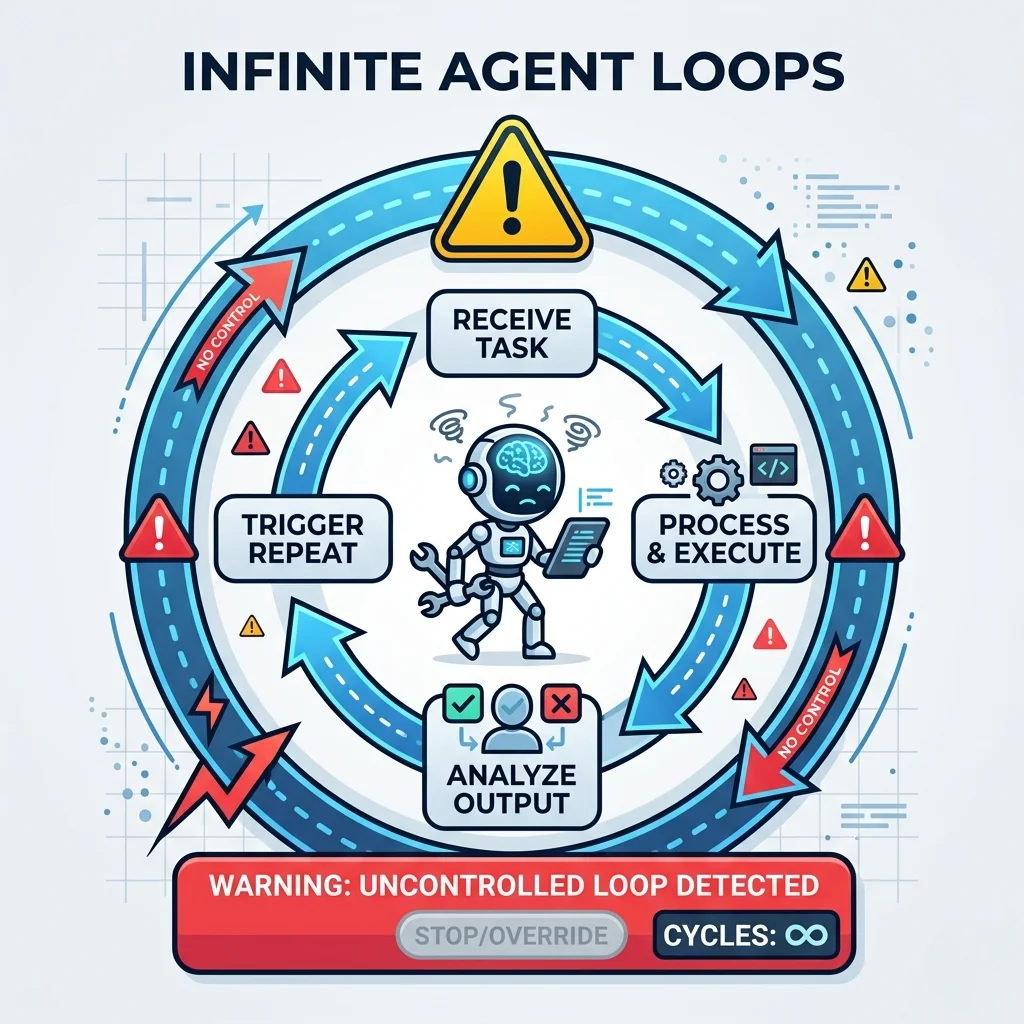
Autonomous agents who operate without the framework of guards are able to:
- Make decisions that can never be recovered once they are made
- No method of escalating an issue if an agent cannot recover it on their own
- Continue trying to complete an action even after it has failed repeatedly
There is often no human intervention in the requirements of the processing.
The Hidden Engineering Realities Most Blogs Don’t Discuss
AI agents are distributed systems with:
- A system for managing state between each step
- Challenges associated with reliability engineering
- Techniques for dealing with timeouts and retries
- Mechanisms for ensuring security, compliance, and maintaining an audit trail
- A way to have significantly increasing costs based on the length of context and the number of retries
These problems are related to software engineering and should be considered software engineering problems rather than AI model-related issues.
Why Scaling AI Agents Is Harder Than Scaling LLM APIs
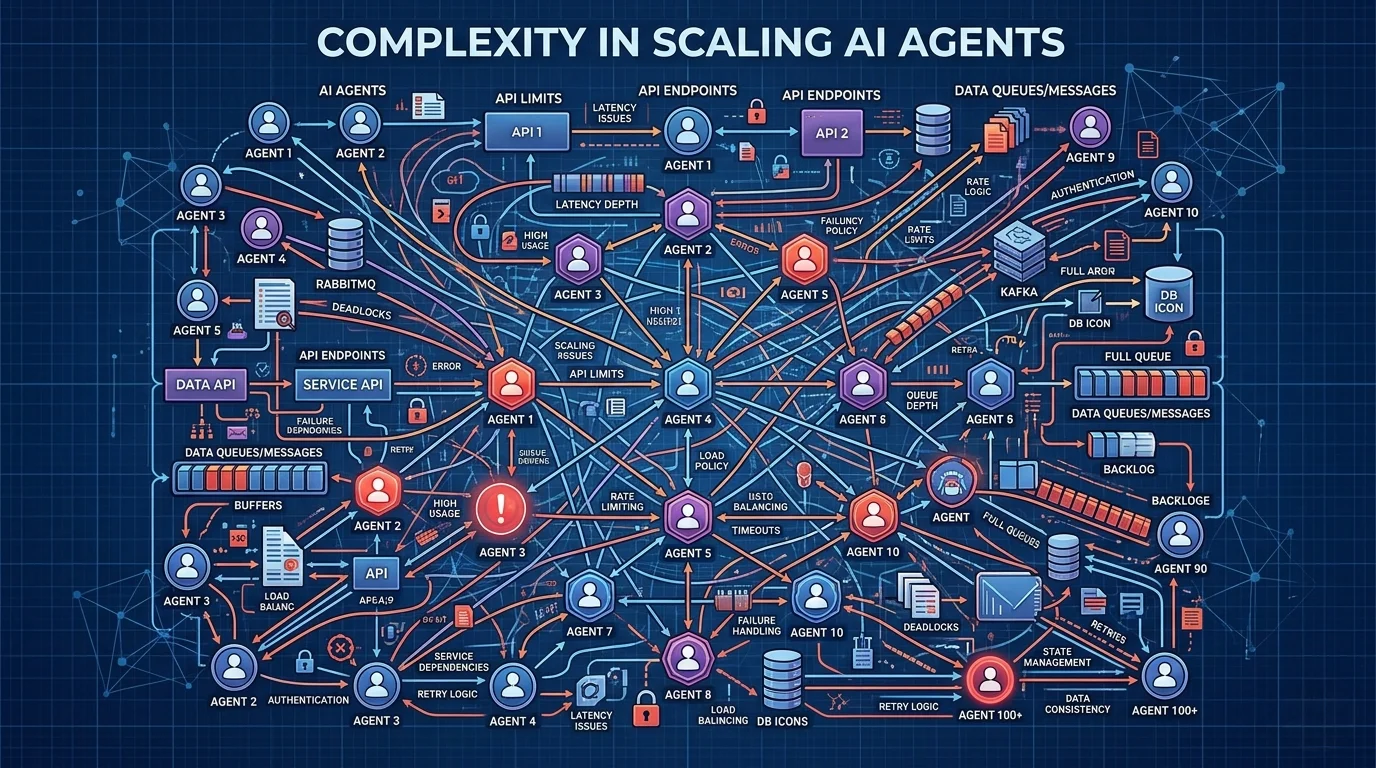
The stateless nature of LLM APIs contrasts with the stateful aspects of agents. There are also challenges related to:
Memory Management
An agent is required to retain context from one stage or session to another (see above). This creates an extra level of complexity with both storing and retrieving the context
Concurrency in Multi-Agent Systems
When multiple agents are executing at the same time, the potential issues they may cause include:
- Conflict over shared resources
- Overloading APIs
- Creating race conditions
Infrastructure Requirements
Production agents will require additional infrastructure components, including:
- Queues
- Retry Logic
- Timeouts
A state persistency layer
Cost and Latency Explosion
When agents are required to retry actions, use longer context windows, or perform multi-step reasoning, the cost of using agents and time required to respond to requests will increase exponentially.
Common Architectural Mistakes
Common design flaws are:
- Monolithic patterns for agents, no modularity for their separation
- No separate architecture for planning, execution and verification
- No fallback or fail-safe methods
- No limitations on execution time or limits to the rate of events
Such designs may work for an initial demo, but do not scale.
How to Build Production-Ready AI Agents
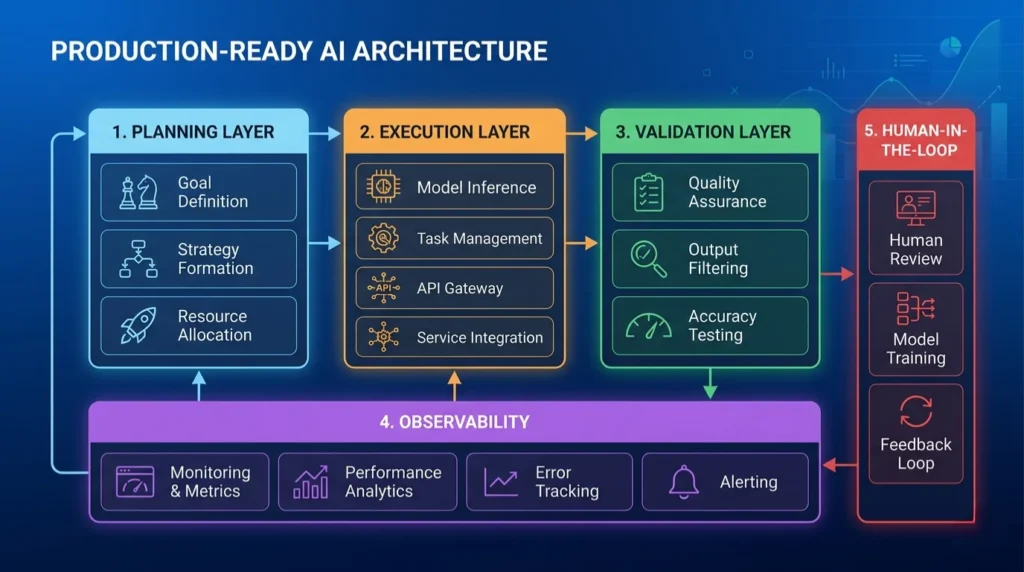
A successful agent is built with the following:
- A clearly defined business outcome
- A deterministic verification layer that determines when an action is justified by its reasoning
- Structured observability and logging of its actions
- A human escalation path for situations that are ambiguous
- Design that includes the ability to retry failed actions
- Continuous assessment of the success of the agent through metrics.
Case Patterns: Where AI Agents Actually Succeed
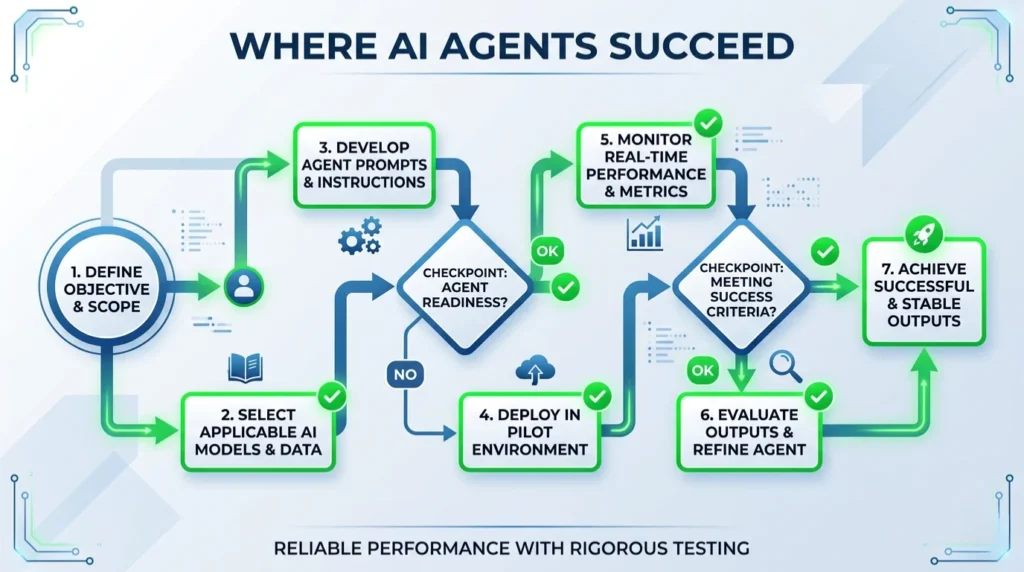
When AI agents work within well-defined and controlled environments, their chances of success increase dramatically. The following factors tend to indicate higher chances of success for an AI agent in these types of deployments:
- Tasks are specific and well-defined and have clear boundaries
- Workflow is well-defined and predictable and has been established internally
- Retrieval-augmented methods facilitate access to validated and relevant data
- Interaction with humans provides oversight through copilot interaction
- Success criteria and outputs are determined before the actual task occurred
- Environments in which AI agents perform tasks are low variance with few edge cases
- Validation or human-in-loop verification of AI agent’s output reduces risk
- Tasks are defined based on their ability to maintain repeatable and consistent results rather than to create new or innovative results
- Existing tools and processes for the organization are integrated into the AI agent’s workflow
Conclusion
Weak models are infrequently the source of AI agent failures in production; rather, agent failures more often result from viewing agents as prototypes rather than as structured systems. Models that are capable can produce erratic results when there are no defined guidelines and boundaries for how to structure the model and using it.
In order for there to be successful implementation, you need to employ disciplined engineering practices. Appropriate design of the system, observability, and verification are key to achieving a reliable system, while constant monitoring using standard operating procedures (SOPs) of your system after you deploy will help you achieve consistent performance from your system over time.
FAQs
Demos have controlled environments, but production has dynamic environments and architectural limitations.
They have significant power and capabilities; however, they tend to be looked at as much simpler than they are.
The greatest risk to production application of AI agents is the lack of validation and observability
Evaluating AI agent reliability generally occurs through standard KPIs such as: completion rate, cost per execution, latency and error rate
Usually not. Most successful implementations of AI agents have additional human safeguards in place.